In this entry I revisit the keynote speech I gave for the 2021 Greater Hells Canyon Council Gala…I posted this on Substack a few days ago, so if you find that platform easier to use, head on over here.
If I ever wrote a manifesto, it would probably sound a lot like this:
When I set out to ground-truth the new Blue Mountains Trail – in a year filled with the global trauma of a pandemic, social and civil unrest, and the heart-lurching consequences of climate change – I found the trail to be a refuge.
Walking soothed the ache of existing in a world embroiled with uncertainty and despair. Walking was a sigh of relief: my brain could relax, my body could relax, and in the absence of the online rage cycle, I could determine what was in my control. Often, I found control in the simplest of tasks, like deciding to eat a frosted strawberry pop-tart instead of a raisin and walnut oatmeal packet for breakfast, or what layers of fleece and gortex I would put on in the bitter October wind. A month filled with those simple tasks created an opportunity to live in the moment, to be fully present.
The Blue Mountains Trail helped me separate what was real: my interactions and relationships with nature and people, from what had been haunting me: a lack of control and power to influence the storm of hate and loss around me.
And what happened when I relaxed into the moment? I was able to find delight again. I marveled at the lasagna layers of canyon rock in Hells Canyon, Imnaha Canyon, and Joseph Canyon; I was transfixed by the blowing golden grasses of the Zumwalt Prairie, and gave shouts of excitement when I spied mountain goats in the North Fork of the John Day River canyon and along the Elkhorn Crest.
Awe, wonder, and delight helped me find my footing again in the world, and those emotions contribute to one of the biggest reasons why I think a new route like the Blue Mountains Trail is more important than ever. The trail is somewhere we can thrive outside of modern anxieties. The trail is where we can just be, and be in a landscape still untouched, in places, by the heavy hand of development.
Hikers who attempt a long journey such as the Blue Mountains Trail will be spending at least a month or more in their quest to walk over 500 miles. I like to call that deep time. To immerse yourself in a landscape and shake off the anxieties and stress of the modern world takes more than a week. In fact, I think it takes more than a month…six months is ideal.
Walking is one of the most intimate ways to connect to a place. Sleeping on the ground, drinking from cold springs bubbling up from the earth, and tracing the contours of the land with our stride is a very powerful experience. The explosion of popularity in thru-hiking since I started my long walks 20 years ago is a testament to that. A long-distance hike can be a truly life-changing experience, and now the Blue Mountains Trail can help us realize how to use that awe and wonder in the natural world to connect people to the specific challenges and hopes of the places we walk through.
Since I started the work of establishing the Oregon Desert Trail (a long-distance hiking route in southeast Oregon), I have evolved my views on the power of hiking to influence change in the world, and consequently, I believe we can ask more of the people who spend deep time in the wilderness.
Walking long distances is a transformative experience…the next step for the Blue Mountains Trail and organizations like the Greater Hells Canyon Council who steward and advocate for the water, land, and life that makes north eastern Oregon a biological refugia, is to take that joy and delight in the places we are spending a huge amount of our time in, and challenge us to become active participants in the future of those places. Someone who spends a month of their life walking beside free-flowing rivers, and then damned rivers, through old-growth forests and then logged forests, can see firsthand what is at stake when we talk about how there is not much land left that isn’t impacted by development and human influence.
I have come to see that the work to protect the last remaining stands of old-growth, and to protect the wildlife corridor that runs from the Rocky Mountains to the Pacific Ocean, is just as, or more important, than my personal experience of hiking the trail. In fact, it’s all connected. I think long-distance hikers are uniquely qualified to speak up and advocate for public land protections.
The Blue Mountains Trail is an opportunity to preach to the choir. Hikers are low-hanging fruit for the conservation community. How do I know? That was me.
When I started work on the Oregon Desert Trail in 2015, it was the first time I really paid attention to the conservation issues that impacted the land and water along the 750-mile route, and to be honest with you, mostly because it was my job. But as I spent more time developing the trail, I realized the conservation mission of the founding organization, Oregon Natural Desert Association, was what made it unique. ONDA created the ODT to engage the recreation community in the conservation issues of Oregon’s high desert. The Greater Hells Canyon Council’s decision to utilize that ethic in the new Blue Mountains Trail was affirming: one conservation organization creating a trail was a novelty; two conservation organizations creating trails is the start of a movement. Together, we can tie the recreation experience and conservation engagement in a more deliberate way.
What makes the Blue Mountains Trail and Oregon Desert Trail unique is that we are asking more of hikers. We are asking hikers to pay attention to the world around them, to pay attention to what makes adventures like these possible, to pay attention to the issues impacting the places we are walking through, and to participate in their future.
Before the Oregon Desert Trail, I had never been asked to do that before. No other long-distance trail had challenged me to pay attention and learn about the forests and wilderness areas I was hiking through, to use my experiences to reflect on public land management decisions and use my voice to help influence environmental policy. So, I think recreation experiences like the Blue Mountain Trail are the way forward as the world is facing the dire consequences of climate change and aggressive development. And trust me when I say that hikers want more: we want a deeper engagement, we want to know how it’s all connected, and we want to know what we can do about it.
We can demand more from quiet recreation in our work, and we need to preach to the choir. How many hikers are out there like myself who have never been asked to write a letter to the editor or comment on a resource management plan in the areas we spent days and weeks walking through and falling in love with? I know there are others like myself who want more trails, want more wild places, want more salmon and cougar and bear. We want to see wolves. We want there to be a full food chain that we are not necessarily at the top of, we want to see fire return to its natural, regenerative role in our forests, not just because it protects the trail tread, but because it protects the entire region we are walking through. We see on foot, we feel through our feet, how it’s all connected. By hiking, we are moving at a human pace; we are moving at the pace of life that has been the pace of life for thousands of years. That connection to the human experience since time immemorial is sometimes easy to forget off trail: that cars and airplanes and a super computer in everyone’s pocket has not always been the way, and in fact, cannot be the way much longer.
By going back to deep time in nature, we are going forward, and by keeping the continuity of a healthy planet and healthy ecosystem at the heart of our actions, we can truly realize our relationship to the natural world.
Through the Blue Mountains Trail we see it, we feel it, we know it, and we act on it.
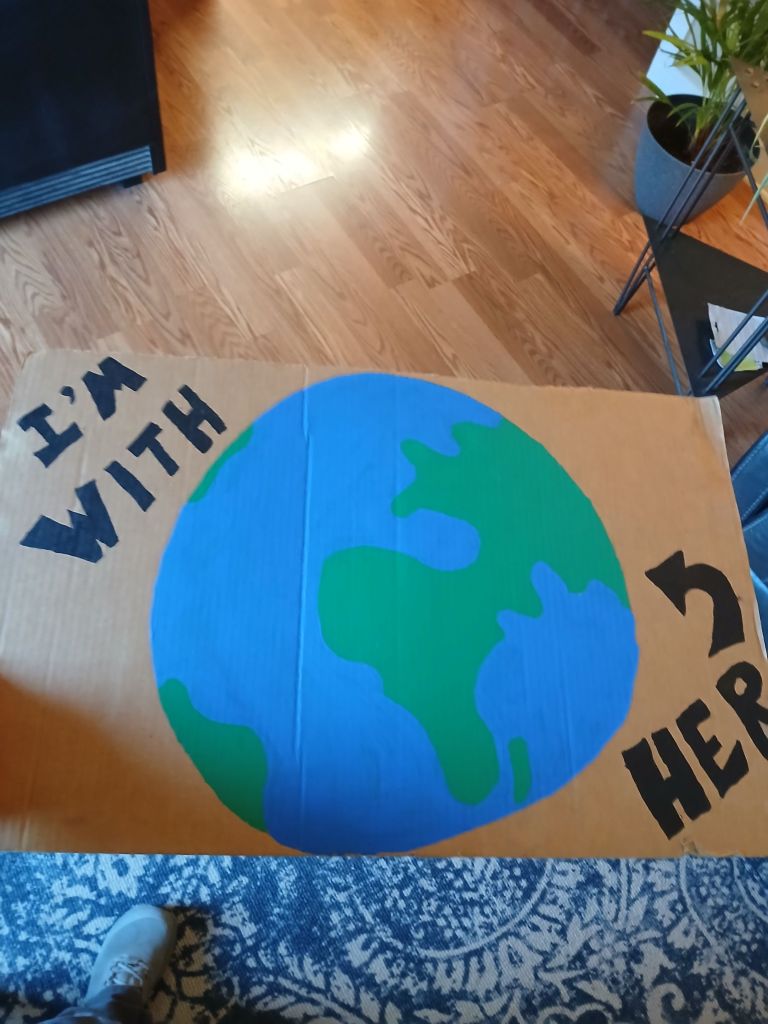
My sign for this weekend. Hope you will find a march near you!
This morning I welcomed the sunrise on my walk, this first day of spring. When I returned home to dabble with some writing, the tears came. (aided by this song…)
My heart is shredding. I’m finally pulling away from my role in crafting the Oregon Desert Trail experience, and it’s much harder than most things I’ve left behind over the years. I’ve evolved through this experience, as a human and a hiker. I have become an environmentalist, and in some ways I feel like a mother.
The grief for what I’ve lost with the change of my body feels incredibly tender; I just can’t bear to continue to steward what I can’t hike. Maybe my attitude will change, but for now it’s too much.
This morning, I cried as I read over years of adventures I’ve had out there. I’m trying to pull out some stories for a collection of hiking essays I’m working on. I thought that hiking stories would be a fun distraction from the cancer memoir, but in a way, both are opening me up to a world of hurt in a way I wasn’t expecting.
The Oregon Desert Trail isn’t just a trail; hikers are embarking on an experience in trying to bridge a cultural, ideological, and political divide.
I think this article from 2018 continues to be one of the best summaries of the larger picture of what the Oregon Desert Trail represents, and what I was trying to do with the experience. Can thru-hiking change the world? I certainly think so, even if it’s just through one conversation at a time.
The trail that cuts through the Wild West of rural land-use politics in Oregon’s high desert.
Ryan “Dirtmonger” Sylva crested a canyon rim and faced an endless expanse of sagebrush. He was hours from any sort of town, after spending days swimming through ice water in Louse Canyon, along a tributary of the Owyhee River in the remote reaches of Southeastern Oregon. He eyed two riders on horseback angling toward him.
“My impressions of the area were from the Malheur-takeover thing. It was really rural and I wasn’t sure what I’d encounter,” says Sylva, a nomadic brand ambassador for outdoor-gear businesses. “Suddenly, I’m walking across this empty expanse and there’s this cowboy coming toward me.”
The riders, a cattle rancher and his son, asked Sylva what he was doing there. Sylva had grown used to puzzled looks from the denizens of the isolated desert, but this time it felt confrontational. Yet by the end of the conversation, he says his views on rural Oregon changed.
Sylva is one of 26 long-distance hikers to finish the 750-mile Oregon Desert Trail. It’s not a hiking trail in the traditional sense. It’s a big conceptual “W” that the Oregon Natural Desert Association (ONDA), a nonprofit dedicated to high desert conservation, scribbled on a tapestry of public lands throughout Lake, Harney and Malheur counties. Unmarked sections require extensive route finding. Stretches of up to 40 miles are waterless.
The trail’s visitation numbers are small, but its true potential is carving a middle path through a longstanding legal feud between ranchers and environmental groups. It’s emblematic of a decades-long public lands debate in the American West, a struggle that has encompassed national publicity campaigns, intractable legal fights, armed takeovers.
As it traverses miles of stunning desert, the trail also explores the philosophy, biology, politics and economics that have made Eastern Oregon a hotbed for natural-resource conflicts. It invites conversation about the urban-rural divide, about land-use policy, about the relative values of traditional agrarian industries and the new-age economy of recreation tourism.
The conflicts in Eastern Oregon run so deep that ONDA, the biggest player in the environmental camp, and rural politicians and ranchers find it difficult to even sit at the same table. But lately they’ve been talking, or at least thinking about it. And the trail has something to do with it. “The more we talk, the more [the ranchers] share why they love the desert,” says Renee Patrick, ONDA’s Oregon Desert Trail coordinator. “When we get out there on the land, we find we have more in common.”
The route spotlights the natural beauty of public lands in counties where a chunk of the populace thinks the government shouldn’t own land at all. On January 2, 2016, armed militants occupied the Malheur National Wildlife Refuge in Harney County. Rancher Ammon Bundy led the takeover to protest the conviction of the Hammond brothers for burning 139 acres of public land in 2001 near Steens Mountain. One occupier was shot and killed, and a dozen others pleaded guilty to conspiracy to obstruct federal officers, firearms violations, theft and depredation of federal property.
Jesse Laird, a rancher in the Warner Valley of Lake County, agrees with Bundy’s message but not his methods. “I felt like the way they went about it was wrong,” he says as he drives his black Suburban toward the looming monolith of Hart Mountain. “They should have gone on a speaking tour.”
Laird turns and points south to a cluster of dun-colored hills. The Oregon Desert Trail drops into the Warner Valley from there, he says. It runs along a paved road, then assails the escarpment of Hart Mountain, entering a national wildlife refuge.
Laird is not shy about his views regarding the Oregon Natural Desert Association and its desert trail. He encourages people to experience the wilderness, he says. His wife, after all, is a professional wildlife photographer. But he’s concerned about the association’s proposal to have the trail designated as a national recreation trail. “I’m scared of designations,” he says. “Special designations always cause special problems.”
In the midst of a flurry of conservationist legislation, President Lyndon B. Johnson’s administration elevated the status of hiking with the National Trails System Act in 1968. In a speech several years prior, the Democrat paid tribute to “the forgotten outdoorsmen of today,” which he defined as “those who like to walk, hike, ride horseback or bicycle.” The resulting legislation created National Scenic Trails, mammoth routes of more than 100 miles that pass “nationally significant scenic, historic, natural or cultural landmarks.”
Debuted in 2013, the exceedingly difficult Oregon Desert Trail has attracted few takers compared with existing National Scenic Trails. According to an informal survey conducted by the Pacific Crest Trail Association, 912 hikers this year have completed the now famous route linking the Mexican and Canadian borders in 2018. Ten people this year have finished the Oregon Desert Trail.
Despite the small number of completions, tourism agencies and the outdoor industry are funding Oregon’s longest thru-hike. The state tourism agency Travel Oregon earmarked the route as one of seven projects that will benefit from its forever fund. Hotels, restaurants and other tourist-facing business donate a portion of their proceeds to the fund. Projects must improve the visitor experience, restore the landscape and provide volunteer opportunities for Oregonians. Last year each of the grantees received around $6,000, a destination specialist with the agency says, and a smaller figure is expected this time around.
Linea Gagliano, a spokesperson for Travel Oregon, says the forever fund money will go toward public meetings and other initiatives to address ranchers’ concerns. “Knowing there was controversy around it, the funds are going to community engagement,” she says. “So it’s something that will enhance communities and not something people feel they just can’t get behind.”
Big outdoor-gear brands have lent support to the trail. The Bend REI store gave grants totaling more than $17,500 for trail maintence. Sawyer Products, an outdoor-gear manufacturer, chipped in around $1,000, and Cnoc Outdoors $2,500. MSR, one of the biggest names in the outdoor industry, promoted the trail on its Summit Post blog.
The unconventional route has also attracted travel write-ups in national publications including The Washington Post and The New York Times. In 2014 The Oregonian reported that the Oregon Natural Desert Association petitioned the U.S. Department of the Interior to study the trail as a possible addition to the National Recreation Trails system.
Seeking to represent ranchers, who are powerful players in the rural economy, the Lake County government petitioned the Oregon Natural Desert Association in January 2014 to halt part of the designation process. They feared that a proposal to connect part of the desert trail to the Fremont National Recreation Trail marked an early step in scenic trail designation. Malheur County commissioners sent a similar letter.
Laird and other ranchers in Lake County don’t have a problem with the trail as is, but they fear designation could pave the way for scenic buffers of up to a quarter-mile on each side. In those buffer zones, agencies could ban motorized use and grazing. Along the Pacific Crest Trail, land trusts have succeeded in converting private land to public to make buffers that preserve a natural experience and allow easier access.
There’s a yawning gap between what rural communities think the Oregon Natural Desert Association is doing with the trail, and what ONDA says they’re doing. Lake County commissioners Bradley Winters and Dan Shoun say ONDA and the Bureau of Land Management have ignored their concerns about designation. “They pretty much couldn’t answer any of our questions about the use, and future use,” Shoun says. The last time Winters sat down in person with an ONDA representative was several years ago.
Three sections of the route—in the Fremont-Winema National Forest, the Pueblo Mountains and Steens Mountain—have received National Recreation Trail designations, but Patrick says ONDA is no longer actively pursuing designation for the rest of the route. “Nothing is off the table,” Patrick says, “but we’re trying to think through this thoughtfully.”
It wasn’t the only time communication broke down in the design of the trail. Alice Trindle, regional manager for the Eastern Oregon Visitors Association in Baker City, barely averted a publicity crisis. She killed an article about the new trail out of fear of offending ranchers.
“There were things [in the article] that really invited the visitor along the trail to go under barbed-wire fences and through gates,” Trindle says. “It didn’t have the respect for those traditional land managers, the ranchers.”
A rancher and owner of a horsemanship business, Trindle is deeply in touch with the region’s traditional industries. While tourism is growing, agriculture and ranching still sustain a large slice of Eastern Oregon’s economy. According to the state employment department, crop and animal production supplied 7.5% of private-sector employment and 7.1% of private-sector wages in 2017. A total $1.7 billion of agricultural products were sold in Eastern Oregon in 2012, the most recent year for which data from the census of agriculture is available. Livestock sales alone generated $762 million.
“There’s a lot of distrust for the big-city environmentalists,” Batty says. “But there are a lot of people in the business community learning to see the value of tourism and willing to overlook the political aspects of it.”
— Thomas Batty
Tourism revenue in Eastern Oregon, though small by comparison, climbed steadily each year, from $316 million in 2010 to $383 million in 2017, according to Travel Oregon figures. About 900 jobs directly related to tourism were added in that time. Gagliano says the past few years in particular have seen a significant jump. There are also secondary effects that ripple through the economy.
Although posters promoting the Oregon Desert Trail hang everywhere from the historic saloon in Paisley to the Summer Lake Hot Springs resort, Lake County businesses have yet to realize gains from the project. Sylva, an experienced thru-hiker, says he can’t see annual Desert Trail thru-hikers ever exceeding 20.
Tourism in Lake County is still largely the domain of the rodeo and a trickle of agri-tourists. Many ranchers don’t know or care that the nascent Desert Trail exists. “They make it up as some big deal,” says John O’Keeffe, a rancher in Adel, a few miles down the road from Laird. “If somebody wants to go out and walk, they can walk there now. You don’t have to make a big effort to make it a trail.”
Thomas Batty, who owns Tall Town Bike and Camp, one of the few outdoor stores in Lakeview, says he’s stocked a bit more fuel for ODT hikers, but otherwise the trail hasn’t made much impact on his business. He thinks that could change, however, as the recreation-tourism sector gains steam. Lakeview is seeing increased visitation from the Timber Trail, another relatively new long-distance route focused on mountain bikers, and the Desert Trail could follow suit.
“This is a pretty conservative area. There’s a lot of distrust for the big-city environmentalists,” Batty says. “But there’s a lot of people in the business community learning to see the value of tourism and willing to overlook the political aspects of it.”
Patrick says most of the tourism boost comes not from thru-hikers but from those who tackle small sections. The immense challenge of the trail plays to the aspirations of the weekend warrior. “The 750-mile ideal is really compelling,” Patrick says. “It’s a reason to go back.” She estimates that each year around 250 people hike segments.
“They’ll buy lunch, dinner, probably spend the night, fill their gas tank while they’re out there,” Gagliano says. “It’s bringing in much-needed economic numbers.”
Duane Graham, owner of the Summer Lake Hot Springs resort, shuttles in a handful of grateful hikers each year from an ODT trail junction 6 miles down the road. In a county where one new job is the equivalent of 520 in Multnomah County, and a group of five people makes a town, no visitor is insignificant.
“We probably will never have the numbers the [Pacific Crest Trail] has,” Patrick says, “but it’s a way to highlight the desert that works with the landscape.”
Given the air of general confusion, red-faced speculation or flat-out indifference in Lake County for the nascent trail, it would have been difficult to expect good results when Patrick ambled into the Warner Valley and ran into Laird at his ranch.
“Oh,” he said, “you’re She-ra.” Patrick was shocked that this rancher knew her “trail name” — a moniker, like “Dirtmonger,” that thru-hikers adopt during their journey. Laird explained that he had been following her blog and the trail’s development, and that he was concerned about possible buffers. Patrick expressed gratitude for the water holes developed by ranchers. Without them, she said, the Desert Trail hikers would go thirsty.
“I felt she was being very transparent and very honest,” Laird says. “I don’t feel like she is — it feels horrible to say — like the other ones there [at ONDA]. A lot of the other ones are out to get us.”
Part of the entrenched attitude of the ranchers comes from their long-standing relationship with the land. In 1867, Laird’s great-great-grandfather arrived in the Warner Valley with the U.S. Army. The Lairds carted in juniper posts on wagons to the Warner wetlands, setting up fencing and water holes for cattle. The early homesteaders fought off sporadic attacks from the Paiute Tribe as they migrated from Reno to Burns. Family folklore has it that one season, the Lairds housed an elderly woman whom the tribe had abandoned. Though she was blind, she always knew when the tribes were attacking. The only property the Lairds lost was one white horse.
Not long after, in the early 1900s, the O’Keeffe family arrived from County Cork, Ireland. They raised sheep but converted to cattle in the 1960s because of labor issues. John O’Keeffe took over the operation from his father in the 1980s after earning an agricultural economics degree from Oregon State University.
O’Keeffe has lived nearly his entire life in Adel, Oregon, 30 miles east of Lakeview. The Adel store, the only store in the unincorporated town, springs straight out of a Western. A group of ranchers in leather chaps and cowboy hats occupies the center. O’Keeffe, a 56-year-old, weather-beaten rancher, wears a white cattleman hat and a grey knit sweater. Laconic and even-tempered, he gives off an air of wisdom, the product of a lifetime of education and experience.
On an afternoon in early November, O’Keeffe’s pickup reeks of smoke. He spent the morning burning the grass around his ranch buildings with drip torches. The burning creates a buffer that starves wildfires of fuel. O’Keeffe is chief of the local firefighting association, a volunteer group that tackles small blazes before they turn into “project fires.” The nearest actual fire department is a 40-minute drive away in Lakeview.
Apart from fire, in any given year O’Keeffe battles droughts, floods, blizzards, coyotes and disease. In winter he drives around all night picking up freezing calves and warming them in a heat box. While ensuring the survival of his herd, he revitalizes the land; he rotates grazing areas, for example, to give native bunchgrasses a chance to store root reserves.
Relatively recently, the environmental movement arrived with new ideas about preserving biodiversity. The 1964 Wilderness Act directed the Secretary of the Interior to review every roadless area within National Park and Forest land every 10 years for a special class of protection. The act famously defined wilderness as land “untrammeled by man, where man himself is a visitor who does not remain.” The legislation banned motor vehicles and harvesting natural resources to maintain an intriguing but profoundly unscientific standard: “primeval character.”
In fact, many varieties of man, from Native Americans to ranchers, have come and gone from land thereafter protected as wilderness. Ranchers say their proactive management strategies, from rotational grazing to prescriptive burning, helped prevent fires and maintain rangeland health.
“I think it’s a fundamental difference in the viewpoint,” O’Keeffe says. “We’ve been grazing here for over 100 years, and it’s still in good condition. We’ve learned a lot about range management over the years and how to graze so that this is sustainable.”
In the 1980s and 1990s, some environmentalists, uniting under the cry “Cattle free by ’93,” argued that sustainable grazing was an oxymoron. In 1987 a Bend resident took out a classified ad urging fellow environmentalists to come by Thursday night if they were interested in protecting public land in the high desert. Each member at that first meeting donated $5, and they dubbed themselves the Oregon Natural Desert Association.
The nonprofit dedicated itself to preserving biodiversity in the fragile high desert. In 1991 it pioneered a method of citizen-led wilderness inventories later adopted by the Bureau of Land Management. In 1994 it convinced the U.S. Fish and Wildlife Service to remove livestock from Hart Mountain, a highlight of the Desert Trail near the Laird ranch, to protect pronghorn antelope and sage grouse. Perhaps most significantly, in 2000 the nonprofit led the effort to establish the first wilderness area in Eastern Oregon, Steens Mountain.
The organization quickly earned the ire of local ranchers. Now, depending on whom you talk to, ONDA is a dirty word. “Most of the ranchers despise them,” says John Ross, owner of the Frenchglen Hotel, a midway stop along the Desert Trail. “They don’t like them ’cause they send environmental things through the federal government and figure out other ways to make it tough on them.”
In 1994, the same year ONDA protected Hart Mountain, Laird’s family lost access to greener late season feed on some 25,000 acres on the Warner wetlands. Laird says invasive Canada thistle proliferated when his cattle were barred from grazing. For another eight years, from 2005 to 2013, the Laird family chose to intervene in a lawsuit filed by ONDA against the Bureau of Land Management over grazing on Big Juniper Mountain. In the effort to preserve their grazing allotments, Laird says, the family quite literally bet the ranch.
O’Keefe remains bitter about the results of a recent case in which ONDA contested the Bureau of Land Management’s inventory of lands with wilderness characteristics. The organization argued for protecting areas with existing roads and water holes, areas O’keefe doesn’t consider wilderness. He says, “they flat out didn’t take in the whole picture.” The negotiations are ongoing.
Actions meant to safeguard the environment, ranchers say, ended up hurting it. After ONDA’s concerns prompted the U.S. Fish and Wildlife Service to remove cattle from Hart Mountain, Laird says, coyotes preyed on deer instead. Cougars came down from the mountains into the Plush valley. “It is an area of critical environmental concern because the BLM bought it,” he says.
The chance meeting between Laird and Patrick laid a small plank in a bridge that needs to span the chasm between environmentalists and ranchers. Patrick was impressed that Laird followed her blog, showed commitment to ranching sustainably and took time after they met to attend a presentation that she gave in Lakeview. By the end of their conversations, she said, “I felt we were able to agree on the beauty of this land.”
The Oregon Desert Trail begins with little flourish or fanfare. A small wooden sign for the Tumulus Trail, hidden a mile down a rough four-wheel-drive road, marks the official start. The route enters the Oregon Badlands Wilderness Area, one of the first ONDA campaigned to protect. In the early 2000s, the Oregon Cattlemen’s Association and a group representing ATV users fought the designation, but the environmental group won. ONDA offered to buy grazing permits at an estimated cost of $100,000, winning over some ranchers. In 2009 Congress designated 29,180 acres as wilderness.
I ran into a local duck hunter near the start of the trail. He said his family owned a ranch in nearby Alfalfa, and he spent nearly 40 years hiking the Badlands with no map or compass. Now, he says, he hardly goes there anymore. There are too many people.
I couldn’t agree, as I didn’t find any more people on a 20-mile loop in the Badlands. The first seven miles of the Desert Trail offered a small sampling of its difficulties. I carried eight pounds of water uphill through sand. The route meandered through scant double-track, almost as if it was designed to lose hikers in a twisted maze of basalt and juniper. I navigated using a map and compass, and REI’s Hiking Project iPhone app, but was still fooled once by a deceptive side trail.
For those hiking longer segments of trail, getting lost and running out of water is a serious possibility — so serious, in fact, that ONDA’s Desert Trail resources run red with legal disclaimers. Patrick notes there haven’t been any cases yet of missing hikers, and she’s been meeting with rural responders. But those words of caution are not enough to appease ranchers and politicians whose rural counties foot the bill for finding lost hikers from cities. “If they get lost,” says Elias Eiguren, a fourth-generation rancher in Arock, north of Rome in Malheur County, “it’s hard to find them and hard to get to them.”
The land exhibits the stunning characteristics of congressionally protected wilderness. Western juniper trees grow much larger than usual. Basalt tumuli, remnants of 80,000-year-old lava flows from a shield volcano, rise up in cracked and tortured sculptures. Mule deer bound through the woods. Everywhere there is solitude and silence.
Patrick says a key function of the Desert Trail is educating hikers about public land like the Badlands. “We need these public lands in order to have long-distance routes,” she says. The route runs almost entirely on public land, and its guidebook describes in detail the eight types hikers will encounter. There are several precursors to wilderness designation, including lands with wilderness characteristics, wilderness study areas and citizen-proposed wilderness. Areas of Critical Environmental Concern also receive special protections to preserve wildlife and plant habitat.
Environmentalists say all these designations are necessary to protect land as it progresses through the lengthy legislative process. Ranchers see needless bureaucracy. Both Laird and O’Keeffe feel crushed beneath layers of wilderness designations.
The dispute can be described as a tug-of-war between two philosophies. The debate dates to the turn of the 20th century, when naturalist John Muir and forester Gifford Pinchot butted heads over their visions for a public-lands system. Some environmentalists, and the authors of the Wilderness Act, sought Muir’s approach of preservation, returning the land to an untouched state. Of course, that prompts a question about what “untrammeled wilderness” means on a planet that is evolving every second. Loggers and ranchers argued instead that conservation — proactive management and responsible resource use — actually lead to better outcomes for the ecosystem. Generally, both sides agree to a mix of both approaches, but the exact ratio is up for debate.
Eiguren falls into the latter camp. He runs 500 head of angus cattle, and he says he’s become frustrated by wilderness and monument designations blocking his efforts to care for the land. “ONDA would like to see the straight 1964 wilderness,” Eiguren says. “If we don’t interact with this land, it dies.”
Toward that end, Eiguren helped found the Owyhee Basin Stewardship Coalition. The group of ranchers and local families is advancing a new management plan for the area. The plan calls for temporarily lifting some wilderness designations to allow ranchers to remove invasive cheatgrass and medusahead rye, introduce appropriate perennial grasses and shrubs, and develop water holes for cattle and wildlife. Eiguren says the coalition is taking feedback on its concept paper and hopes to present to the legislature in the next few years.
The rancher says tensions with ONDA have cooled since the push for the Owyhee Canyonlands monument, a campaign sponsored by Keen and other outdoor-gear manufacturers, along with environmental activists. But the whole thing feels like a dry grassland in summer — it could ignite at the drop of a match. “I think we’re talking more, just because there isn’t a big issue right now,” he says. “Things could get tense in a hurry.”
“I think we’re talking more, just because there isn’t a big issue right now. Things could get tense in a hurry.”
— Elias Eigurn
When Sylva opened a conversation with the cowboy at the edge of Louse Canyon, he kept talking about the nearby Owyhee monument. He seemed cautious. He suspected Sylva might be a clueless urbanite or, worse, an ONDA member.
But then they began poring over maps. The rancher helped Sylva find a water source; Sylva pointed the rancher toward his missing cattle. “He definitely let his guard down when I was communicating about the land,” Sylva says. “He then had a respect for me that I knew the area and was able to help him find his cows.”
The Oregon Desert Trail evokes suspicion in some rural ranchers and politicians, but others see an opportunity for common ground. Unlike many other ONDA projects, the Desert Trail has benefited from the support of ranchers. Patrick spent long hours talking with the many private landowners along the route. She never ran into pushback, she says. Some ranchers even offered hot showers or water caches for hikers.
Laird and I certainly do not think the same way about wilderness or the Malheur takeover. But in just an afternoon, I could empathize with some facets of his frustration. He doesn’t want to get 15 signatures on a 34-page document to access one water hole. He doesn’t want a hiker from Portland pulling up fences on Hart Mountain without understanding the families who put them there 150 years ago.
Those dialogues might seem like small steps, but considering the decades of bitter legal battles that have characterized this land, they are giant leaps. The opportunity for further bridge building and discussion among polarized groups sets the Oregon Desert Trail apart from its long-distance brethren.
“I saw polar opposites probably more than any place I’ve walked,” Sylva says. “It’s all intertwined around public land. But there’s still that common bond, and it all revolves around the landscape.”
11/14/18: This article has been edited to reflect the following corrections. The U.S. Fish and Wildlife Service, not ONDA, made the descision to remove cattle from Hart Mountain. In the ligitation over Big Juniper Mountain, ONDA sued the Bureau of Land Management, the agency that owned the land on which the Lairds ran their cattle. The Lairds voluntarily intervened in the case.
***
My comment post publication: I want to address one issue mentioned in the article about hikers going under fences and through gates. There are hundreds of fences on public land throughout Eastern Oregon, and it is perfectly legal to go over or under those fences or through the gates. I urge respect above all, and want hikers to realize that not all fences mean private land, and not all private land is fenced. I have clearly marked private land on the ODT maps so that hikers can know where they can and can’t go. Gates are to be left as they are found. We as hikers want to be respected as we travel through public lands, and the land owners want to be respected for their livelihoods and traditional ways of life. I also urge hikers to think about the people who lived on the land and traveled through it before modern civilization. Eastern Oregon has the oldest traces of humans in North America along sections of the Oregon Desert Trail; sites of First Nations people are dated back to over 14,000 years ago, and another site hasn’t been verified, but dates back to over 16,000 years ago. Hikers will pass by many areas of significance to these original habitants of Oregon.
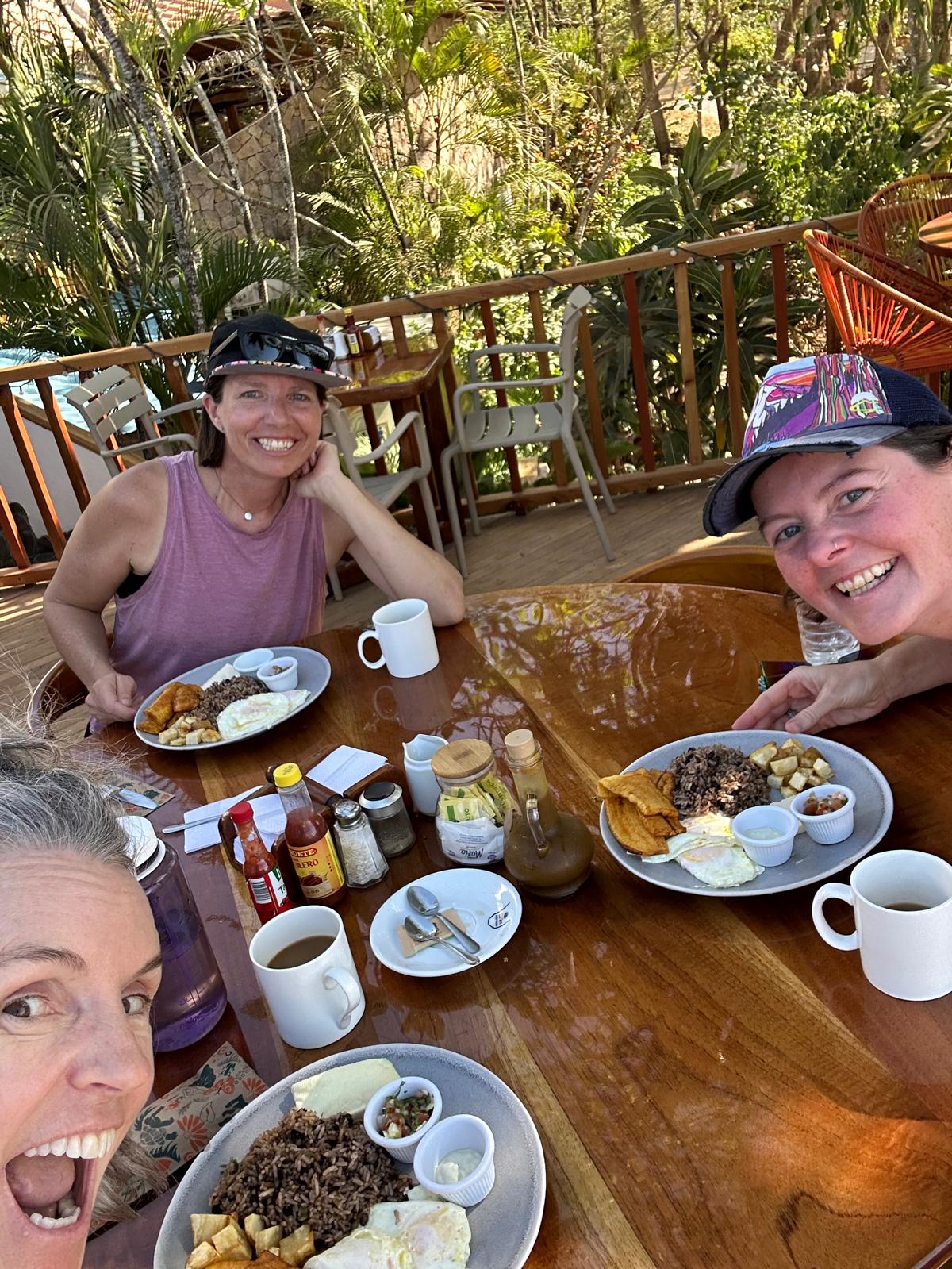
“Leap and the net will appear.” I found myself saying to Bumblefoot, a 33-year-old PCT hiker from Canada who sat across from me at breakfast in Costa Rica this morning. The very fact of a conversation that veered towards the existential angst of living in a world of infinite choice, possibilities, and uncertainty was a beautiful thing. That we were both PCT thru-hikers? Mind-blowing.
My sojourn in this Central American country is coming to an end soon, and it’s been a wonderful investment in time, energy, and money…despite needing to pop frequent pain medications and wear my neck brace from time to time.
As most of you know, I’m operating under the “retire as I go” life plan, as I have done most of my life. This trip to Costa Rica fits right into that philosophy – even with incurable cancer. Strike that…especially with incurable cancer. I need to live as hard as I can right now because my next brain MRI is scheduled for shortly after I return. Someone in my position can’t get off the treadmill of living in three-month intervals between scans and labwork and doctors’ appointments. The possibility of being struck down at any point still lingers close to the surface of everything I do, so I’m practically throwing myself at life.
The jarring whiplash of existence with an incurable disease when I’m feeling pretty good right now is agonizing. Is it incurable or terminal? What is the right terminology? People in my writing retreat this week asked why I use the word incurable when chances are that I will die from this disease. That word choice is intentional. It’s easier to live when I say incurable, much as it’s easier to live when I say remission rather than NED (no evidence of disease). Some in my position would never use the “R” world to explain their current state. The reality is an NED status is a snap-shot in time, and the tests used to determine that status can’t see down to cancer cells smaller than 8 mm, so there very well could be some dangerous little buggers still swimming around in my body, waiting for my immune system to drop its surveillance, or stressors to mount to a point where the barrier has worn down and they can take hold again. In a way, I use the word remission as an illusion of control. Illusions mean everything. I choose to believe I’m cancer-free. I choose to believe I can live a full and fulfilling life despite my physical disabilities. I choose to live.
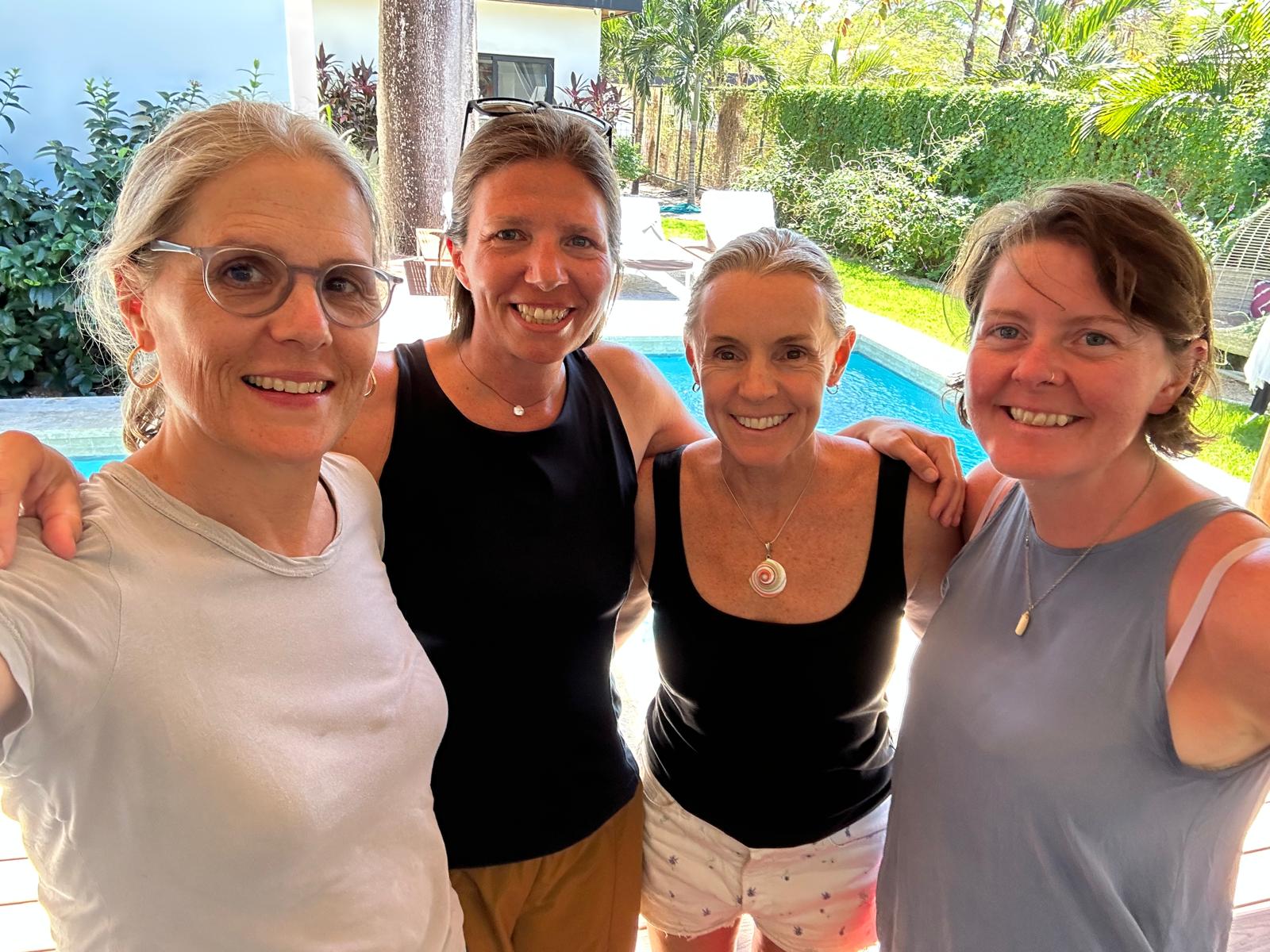
I came to Costa Rica to take part in a writing retreat with my friend and fellow hiker Anish (aka Heather Anderson) and to explore my book ideas with the other participants. Something that kept surfacing when I noodled on my memoir, was that I refuse to operate from a place of fear – the fear that would keep me from fully engaging in life. I refuse to give in to the fear that could keep me at home, wrapped in bubble wrap, instead of walking the beach in search of sea turtles and dodging crocodiles in the nearby estuary. That’s not how I’m choosing to live.
The retreat participants: Boo, moi, Heather & Johanna
I’m choosing to live, especially after watching Andrea Gibson’s documentary yesterday, Come See me in the Good Light. That film highlighted the fragility of what we are dealing with here. If Andrea can die three years after the first diagnosis, then so can I. Cognitive dissonance then reared its head when I read an enlightening Substack post by Oncologist Daniel Flora, When the End Doesn’t Come, about how many of us with incurable cancers are living far beyond their initial life expectancy and enter a kind of limbo where we know we might be like Andrea, but we also might live for 20 more years. WTF? Can you imagine living the rest of your life thinking that you might be given a death sentence every three months? Even when you are feeling good? Welcome to my world.
Jenny (or Bumblefoot) and I have talked about life in the way most people only achieve in years-long friendships. That’s the magic of meeting someone on a long trail, in a foreign country, or when living with stage-four cancer, or in this case, all three. She and I both expressed our delight in sitting across from one another and finding out we had a shared experience. The serendipity of it all. I relayed a story about when I had just arrived in London for grad school and was very uncertain that I had made the right decision. I sought out refuge from my oscillating emotions on a visit to the Museum of London. I walked in the door and was greeted by one of those life-sized cardboard cut-outs that you can put your face into. The cutout? He-Man, thrusting his sword into the air, calling upon the power of grayskull, much like I had done the previous year on the top of Blood Mountain on the Appalachian Trail when I received the trail name She-ra. Well, that museum exhibit and silly photo I took with my face shoved in the cardboard cutout became a sign that I was in the right place in the right time. I gave myself permission to follow the breadcrumbs of my curiosity and fully invest in life in London. I feel the same way about Costa Rica, not just because I was getting to learn from Heather and her process in writing three books about thru-hiking (heads up, you can buy her new book Farther now), but also because the main facilitator, Johanna Garton, grew up close to me in Wisconsin. I went to school in Waupaca, and she, 40 miles away in Appleton. I live for those coincidences. I live for those breadcrumbs. Coming to Costa Rica and investing in this retreat means I’m on the right track.
So I’m going to continue trusting the world. Continue to believe that I can do this, that I can live a full life despite the pain and uncertainty. I hope you can too.
P.S. Johanna has a few more writing retreats coming up this year. Soak in the pura vida vibes in Playa Grande and get some excellent feedback and direction on your writing project. Find out more here: Costa Rica Writing/Yoga Retreat
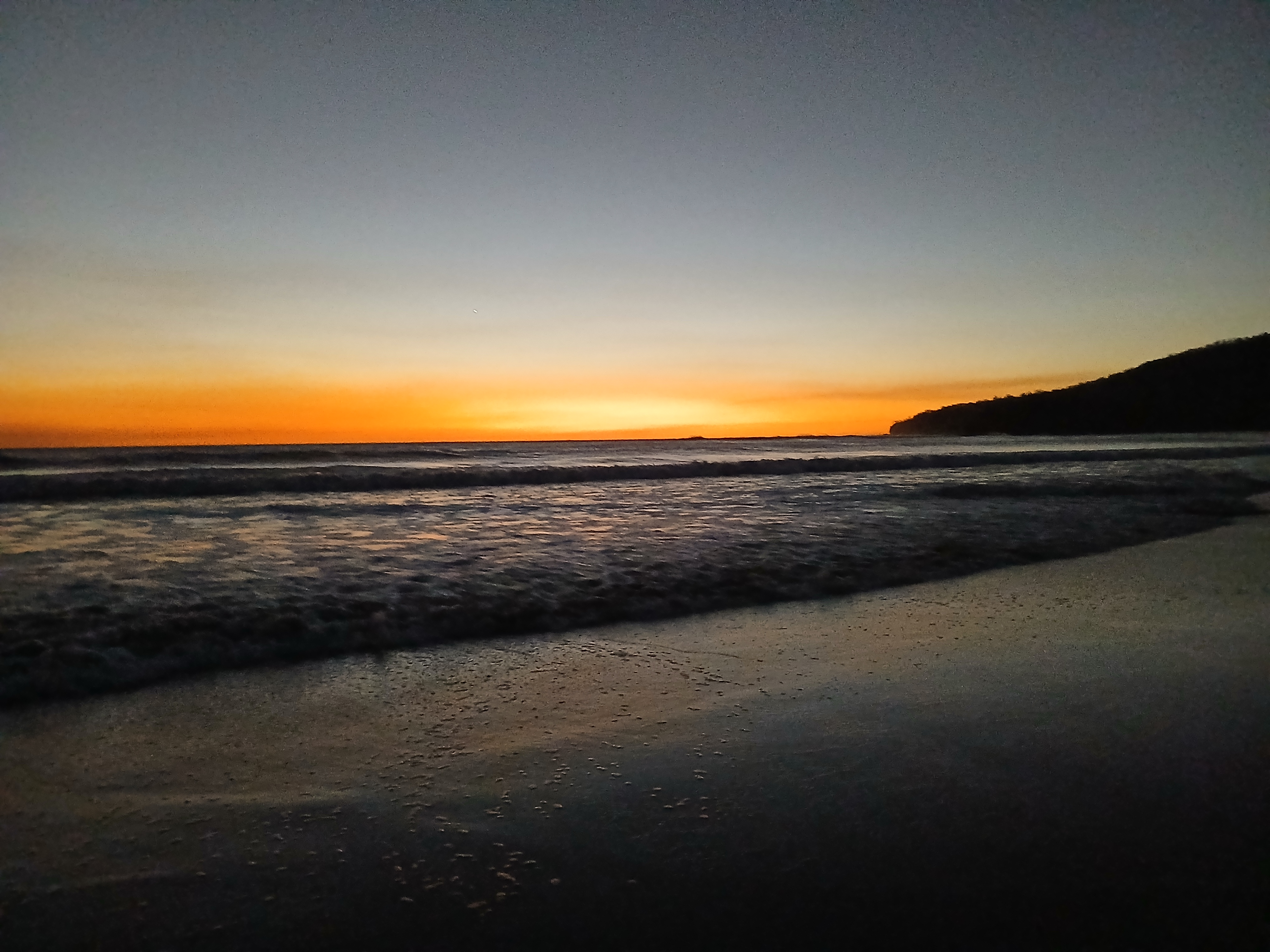
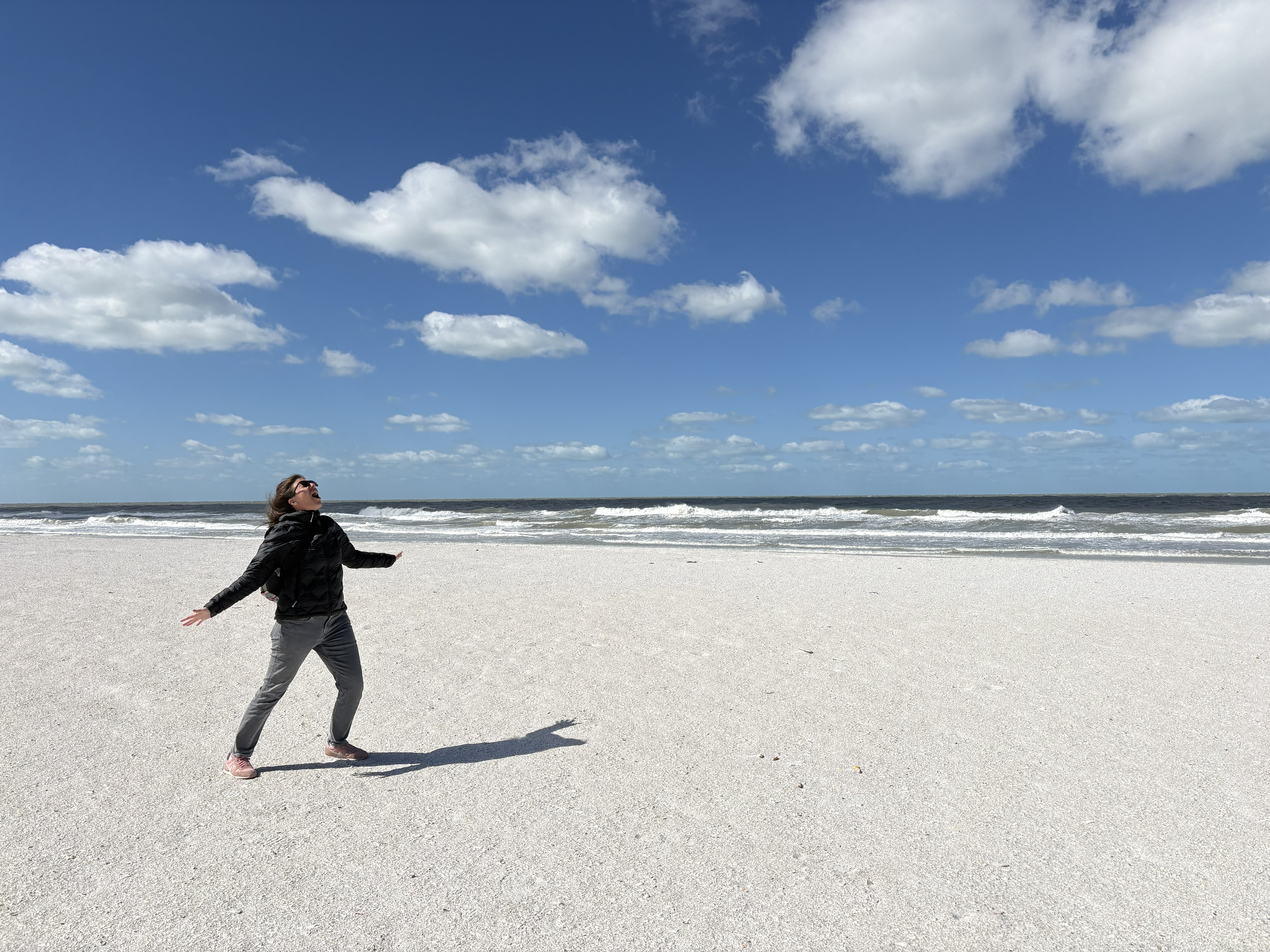
I just got home from a visit with my good friend Mary. I don’t even remember her snapping this pic, but it resonates. Big time. Is my howl about our seemingly unescapable trap of war, abuse, violence, climate change, and a robot sentience that will change humanity forever? Oh yes, it could be. It could also be an agonizing scream about confronting what my body may or may not be able to do in the future, the ever-present pain, the memory of how I filled my days just a short while ago, and the uncertainty of it all. Or maybe it was just a howl to howl.
We walked that beach for miles and miles. I walked more last week than I have in any of the months since returning from the Camino in September. Mary is a triple crown hiker too. We were supposed to hike the Hayduke Trail together this year, in the before times that is.
Letting go of the before times is proving to be a level of difficulty that I haven’t been able to manage yet. I still keep getting trapped up in what I used to be able to do. In fact, just two years ago in the 8 months before I got injured/sick, I paddle boarded the John Day River, backpacked a 100-mile section of the Idaho Centennial Trail, backpacked around Big Bend National Park for a few days, hiked a loop through the Gila Wilderness along the CDT, created and hiked a short 3-day loop around Smith Rock State Park, skied up to Broken Top to camp/ski over Memorial Day Weekend, packrafted the Umpqua River, hiked the Lost Coast Trail on the NorCal coast, backpacked 60 miles of the PCT again, and day-hiked into the Eagle Cap Wilderness. That year represented my typical outdoor adventure pace. I went hard, but also a bit slower as the years had extracted some toll on my body.
In my struggle to get over the fact that I will never adventure like that again, I’ve been revisiting some of my past exploits. This video that I filmed with Oregon Field Guide in 2017 really sums it up. Establishing the Oregon Desert Trail was the pinnacle of my adventuring, and being able to translate those adventures into something tangible was everything. To create the current version of the route, I packrafted, skied, hiked, navigated, sweated, bled, howled and more…I laughed and glowed, at moments I burst with joy, and at others, cried with fatigue. This movie shows you the reality of the kind of experiences I think we need more of, that I wanted more of.
It was all so good, and I’m glad I could go that hard for so many years before I was struck down.
And that takes me to something my visit with Mary left me with: a reminder of how resilient I am, have been, and continue to be. Two things can be true at the same time: I am damaged, and I am resilient. I choose resilience.
 She-ra Hikes