It’s Time to Re-Read Everything

I flew down to see my Mom recently and got the heady experience of hanging out in the clouds for a while. The plane hit a bit of turbulence after takeoff, but that was because we entered the world of fluffy white poofs; I was glued to the window. I’m sure I’ve taken other plane rides like this one, but we kept going in and out, parting the mist and vapor, and it would all close in around us again. And always there was more floof and always more poof. It was exciting and took me back to childhood dreams of flying. You know, if I could fly like superman: point up and go up. This is what I imagined it to be.

I was torn between watching the clouds and re-reading a classic. I kept going back and forth, both were so rich and exciting that I couldn’t decide which to concentrate on. I didn’t remember 1984 as an exciting book when I read it as a high schooler. Sure, there were the main takeaways of gaslighting and control, but there was so much more in my reading this time around. Do I need to revisit all the classics that I’ve already crossed off my list? Time and experience are opening new portals into the sentences. 

1984 is an amazing book to read as a study of the craft. I kept turning the pages, wanting more: the plot pulled me forward, sometimes pushing, and it was difficult to put it down to wonder at the sky that passed by my window. I want to create a work of art that compels readers along in the same way. It won’t be a world of thought police; our phones do a good enough job there now (in fact, reading about a world where thought police exist helps me find gratefulness for the freedoms and pleasures that I do have – for now). And it holds up. Wow this book holds up. So, yes, it’s time to reread everything I’ve ever read… to think that I might be capable of creating something half as beautiful is a dream. But flying through these clouds is a dream too.


Since commenting has been so buggy on this website, I’ve decided to share these posts on Substack where commenting will be much easier. Note: My substack is free, so please choose “no pledge”.

The Hard Truth

All of this will end.

As I have experienced the destruction and reconstruction of my body this year, I’ve had to face the hard truth: I will die. My dad died this year. We are all going to die, some sooner than others. 

Writing through my illness has helped me focus on what is left: life. I am still alive, my mom is alive, many of my friends are alive, and even though the world looks different through that lens now, I am still alive, so how am I going to live with the knowledge of death? 

We all have to face this, no matter how much we ignore the simple fact that humans don’t live forever. Add in some other truths: like many other systems around us are on the brink of collapse as well, and the futility of it all easily opens the door to despair. I struggle with it, and I know many of my friends struggle with it too, so when I saw a link to this video, I clicked on it more out of curiosity than out of the expectation of an answer.

I came away electrified. Sarah Wilson had come to the same conclusion that I had with my cancer.

As Sarah said, “I feel more alive and connected than ever before. The urgency of what is going on has forced me into living fully and living fully now.”

Yes. This.

Conveniently, on my “living fully now” list, is the desire to create my own TED talk. I don’t love public speaking, but over the ten years I spent developing the Oregon Desert Trail, I gave at least 100 presentations about the trail and faced my fear of forgetting how to talk in front of crowds of people. I still get sweaty palms, but by speaking in front of strangers, I have been able to build connections and foster curiosity in others, something that compels me to keep going. A TED talk is on another level than speaking at a small library… it could get filmed and posted like Sarah’s was (if I’m lucky), but I’m not going to let that stop me. 

There is something here I want to say, and I’m still figuring out how to say it. The workshops, conferences, and books I’ve immersed myself in the last month are helping me pull memories and insights from the fog of my experiences and throw them into the soupy mess that will become my memoir. I think creating a TED talk will help me solidify my intent while putting pen to paper.

Luckily, the Bend TEDx conference is coming back next year. I will apply, and if chosen, will try out some of the content I’ve been working on for this book project. Deadlines can cause panic, but they can also force action, especially when I’m in the formless shape of an unstructured life. I definitely strive to bring structure to my days, but sometimes that all falls apart and I’m left a puddle on the couch, staring at the wall. 

So if you find yourself staring at the wall too, overwhelmed by the impending collapse of everything we know, it is helpful to ask yourself: 

If this was my last day, last week, last month, what would I want to do? 

And then do one of those things. And write them all down on a list, and do more of those things, and so on and so forth. Before long you may be living fully in the present or maybe you will discover you have already been doing that. What I’m trying to say is, please do those things now instead of waiting to act until the day when everything is perfect…that day may never come. It’s cancer; it’s a climate catastrophe in your city; it’s an authoritarian government that takes your rights away. It almost doesn’t matter what it is. 

Live now. It’s all we have.


Since the commenting has been so buggy lately on this website and an upgrade would be very expensive, I’ve decided to share these posts on my new Substack where commenting will be much easier. So head over there if you want to leave me a message. Note: My substack is free, I am not accepting payments at this time, so feel free to choose “no pledge”.

This Is What The Maintenance Phase of Stage 4 Cancer Looks Like

FYI – It’s ALOT of work.

View from a recent walk along the river trail

I’ve been home from the Camino for about three weeks now, longer than I was away on the walk, but time did that sneaky thing again, and months of life seemed to happen in 18 days. Time distorts when you step away from your normal routine. It extends your life. And I find that returning from travel helps me find comfort in my daily habits and favorite things – like the hot mug of green tea I bring into the office for my morning writing sesh while snuggling into the blanket that has a little foot pocket to warm my feet. Going away helps reorder life when you get home.

Just what have I been up to these past three weeks, other than rearranging everything to live the life of a writer? Well, doctors’ appointments, of course. It takes a lot of work to monitor and heal from this incurable disease. Note: many of the people I’ve known who have passed from cancer did so within a year of their initial diagnosis. I’m almost at month 10…and continue to feel I will be in the minority.

So, in the spirit of oversharing…here are all the details. Since getting home, I’ve had:

  1. An appointment to replace my metal nose ring with a glass one, so it wouldn’t interfere with my brain MRI the next day
    • Metal rings in noses are an issue for MRI machines. Did you hear about the guy who died when his large metal necklace dragged him into an MRI room? Kirk can’t have an MRI because he’s been a metal worker for so long that a small piece might be embedded in his body, and could get ripped out when he approaches the big magnet. Yikes! Anyway, I ordered a nose ring that will be easier to remove for future scans because the one I have now is a full circle of metal with a ball on one end. To remove it, I need to twist it open enough to pop one end of the post from the ball and then pull the ring apart to make an opening big enough to twist it through my nostril. That hurts. And I couldn’t get the loop closed when putting it back in after the MRI because my fingernails are now breaking, and even a slight bump will cause fractures and splits. I understand this is because they have finally grown out to reveal the effect chemo left on my body nine months ago. Also, Tegresso, my daily cancer med, can cause weak nails as one of the side effects. 
  2. A brain MRI
    • A motorized tray slid me into a circle of magnets the day after I got home. Usually, I see test results the same day in My Chart, and when I get them, I am often tempted to type words or phrases that I don’t understand into a search engine (as you already know from this section: Interpreting a My-Chart test result in the middle of the night with no doctor supervision). But when I finally did get the results, there wasn’t anything to worry about because the tumors are still shrinking. THE TUMORS ARE STILL SHRINKING!!!
  3. Labs
    • The day before every appointment with my oncologist, Dr. Tiffany, I have labs drawn. My neutrophils absolute and hemoglobin are monitored, and we have a sharp eye on my platelet levels. Another of Tegresso’s side effects is low white blood cell and platelet counts. That means I’m more susceptible to infections. This time, most of my numbers were similar to previous labs, but my liver enzymes were up, which I attribute to all the wine I drank in Spain. No one is worried, though. I brought up the results with several of my doctors, and all thought the health benefits of drinking wine in Spain while I walked 170 miles outweighed the negatives; plus the numbers are still on the low side of high. So these results have been placed in the “don’t worry” column of “bad things that might happen.”
  4. A trip to the gynecologist
    • Since my body got nuked with chemo and radiation at the start of the year, I haven’t had a period, and was quite perimenopausal before (think hot flashes and brain fog). I had my hormone levels tested a few months back, and found numbers hovering around non-existent. My doc prescribed progesterone and estrogen (both in a patch and cream form), and the change was dramatic. No more hot flashes, a clearer brain, softer skin, and as I described it one day on the Camino, it felt like my body was waking up, that I was coming alive again. 
  5. My first Zometa infusion
    • Since I had so many tumors along my vertebrae from neck to pelvis and femur, I am at risk for fractures. The swiss cheese effect of the hungry cancer put me in a wheelchair until radiation could harden some of the bones that would keep me walking, particularly in my pelvis. But good news: the bone is slowly growing back now. The bad news: combined with the osteoporosis risk of menopause, I still have a fracture risk. Fortunately, the hormones that work for hot flashes also work to strengthen bones. 
    • Now Zometa is a bisphosphonate medicine that alters bone formation and breakdown in the body. This can slow bone loss and may help prevent fractures. Since my chemo port was removed in August, I’ll get my infusion the old-fashioned way – needles and tubes in my arm. Every three months I will head up to the transfusion room at St. Charles Hospital to get a vein poked while looking at the Cascade Mountains. Back in the day when I worked at the art magazine in town, I made one of the first tours of this facility when it opened…it was state-of-the-art, and hosted works of many local artists. I never imagined I’d be back a decade later to sit in one of those chairs.
    • Dental clearance prior to taking Zometa is needed as one of the nasty side effects could be bone loss in the jaw, and those of us who have been treated with chemotherapy, radiation, or steroids might be more likely to develop it. I got the dental clearance a few months ago, and I’ll be flossing regularly, thank you very much!
  6. A massage
    • My neck continues to struggle holding my head in the right position. I especially feel it on walks and at the end of the day. I expect my muscles tightened when I got home and sat down more than I moved, so when the massage therapist found a lot of knots under my shoulder blades, I was grateful for the release. 
  7. An appointment with my naturopathic oncologist
    • During my check-in with Dr. Neubauer, we discussed ramping up the dosage in my mistletoe injections…the goal is to have a 1” rash at the injection site most of the time. And if you don’t remember from one of my previous posts, mistletoe has a host of beneficial effects, like helping the immune system recognize and destroy the cancer by activating tumor-killing cells such as macrophages, dendritic cells and natural killer cells.
    • One of Dr. Newbaurer’s suggestions this time was to increase to my calcium citrate each day. More calcium will offset a loss when the Zometa draws the mineral from my blood to deposit it in my bones. 
    • And now that my body is in a stable state, she wanted me to get another set of labs to measure the levels of copper and zinc in my blood. An imbalance can cause tumor growth. 
  8. More labs to measure copper and zinc
    • Results pending.
  9. A visit to my palliative care doctor
    • Dr. Blechman is wonderful. This woman was the first doctor I could get an appointment with after returning from Louisiana and my emergency surgery after diagnosis. She immediately saw the urgency in getting me in to see an oncologist, so much so that she walked down the hall, had a few words, and I was talking with Dr. Schmit a short while later…chemo started the next day. Dr. Blechman has my back; they both did. One of the first things she shared with me when we met last week was that she, too, went on a Camino-style hike in Italy this summer. Complete with hotels and cafes and luggage transport… and she thought of me and my Camino. I expressed my gratitude to her, and we shared a few tears of joy. My pain is very manageable right now, and I’m at such a steady place that we agreed our appointments from now on would be TBD. Magic.
  10. A trip to see my oncologist
    • I had a smooth transition from Dr. Schmidt’s care to Dr. Tiffany this summer when the cancer wing at Summit Health closed down, and Dr. Tiffany has been nothing but supportive of my recent activities. At the appointment, we reviewed my labs and brain MRI, talked about Zometa, and covered a few various other small issues I’ve been having. All signs point to stability, so I am moving from monthly labs to an every three month schedule along with my scans. Winning!
  11. A physical therapy appointment
    • Melissa Carlton is supportive and gentle. She works on my shoulders, back, and legs – stretching, assessing, and determining how to best address my current aches and pains. Right now, that looks like a sore and tight lower back. Melissa reminded me that I had weeks of daily radiation pointed at that part of my body, so the stiffening is not surprising, and wearing a lumbar pack for two and a half weeks probably helped set it off. The discomfort is bearable, but it also feels like a spring that’s loaded and ready to pop, so the strategy is to strengthen my core, use topical creams like magnesium at night to soothe it, and add in hot epsom salt baths and heating pads during the day. Melissa also wants me to try wearing a light backpack to see if a little weight on my shoulders might help both my posture and my lower back. Lets do it!
  12. An acupuncture appointment
    • The lower back work continued with my acupuncturist, Kym Garrett. Again, a knowledgeable, compassionate, and supportive practitioner that I’ve been seeing since early this year. This time, Kym used her needles to help ease my lower back and shoulder tightness and suggested other methods of anti-inflammation. I know I need to eat less inflammatory foods… I’ve slowly slipped sugar and refined flours back into my diet lately (mostly in the form of pastries and breads), so I want to cut back. I’m still taking so many pills that I don’t want to add another unless absolutely necessary (see below). Ahhh, I still remember the days when I didn’t take any. Most of my life, I’ve never needed to take any medication, so this new reality is still an adjustment. My daily pillbox now carries 17 gelcaps and tablets that I take spread out between morning, noon, and night. Yikes.
  13. A neurosurgery appointment
    • I’ve been seeing Dr. Tien for follow-ups on my neck surgery, and because it can take such a long time to heal (and I still have a collapsed vertebrae) he wants to continue to see me every three months or so. Usually, I have an x-ray done so he can see how the screws and mesh are doing in my neck, but since I had the brain MRI recently, he was able to reference that and didn’t have any concerns, in fact he was quite impressed with how my body is healing. Good job neck 🙌

So what medications am I taking in this maintenance phase? Things keep changing as my body is changing, so this list of drugs is a snapshot in time. 

  • I’m taking 17 pills a day, and then there are also shots, powders, and creams.
    • Mistletoe
      • According to the National Cancer Institute, mistletoe is one of the most widely studied complementary and alternative medicine therapies for cancer. In certain European countries, extracts made from mistletoe are among the most prescribed therapies for cancer patients. (This is a Dr. Newbauer-prescribed medication)
      • I give myself an injection of mistletoe on Mondays, Wednesdays, and Fridays, and I’ve been slowly ratcheting up the dose so I get an immune system reaction of a 1” rash at the injection site. So far, I have no other side effects other than the lack of active tumors. 
    • Estrogen
      • One of my hormone vectors is an estradiol patch that I replace twice a week. I place these small, clear disks of sticky below the belt, alternating between my left side and the right.
      • The other estrogen product is a cream that I use nightly on my lady parts.
    • Magnesium
      • I apply a magnesium cream on my lower back every other evening before bed to help it relax during the night.
    • Astragulus
      • I take powdered astragulus mixed in water every day. This tonic helps my bone marrow, blood counts, kidney support, and has shown increased survival in clinical trials. (A Dr. Neubauer medication)
    • Mushroom powders
      • I put a powdered turkey tail and reishi mushroom mix into my coffee in the mornings (Note: only one cup of coffee most days). Turkey Tail mushrooms are known for their high levels of beta-glucans—compounds studied for their ability to help maintain a healthy immune system, and the benefits of reishi mushrooms are listed as: supports immune health and resilience, supports mood and emotional well-being, promotes restful sleep and relaxation, supports energy, vitality, and healthy aging, helps maintain general wellness and resilience to stress, promotes cardiovascular and circulatory health and helps maintain healthy blood sugar metabolism. Of course, these benefits are from a label, but these mushrooms are Dr. Neubauer-approved. Note: next time she wants me to buy the 5 Defenders brand due to its 100% hot water-extracted process. The hot water method ensures that the powder contains more than 20% beta-glucans, which are known for their immune-supporting properties, and it unlocks the full spectrum of beneficial compounds.
    • Nail polish
      • To help harden my nails from the chemo and cancer med side-effects, I’m now using a clear strengthening polish. 
    • Now for the pills:
      • Keppra
        • Since I had a few seizures earlier this year, I’ve been put on this anti-epileptic drug. I have been thinking of coming off of it, and when I do so, I’ll need to avoid driving for three months because the lack of keppra can also cause seizures (ironic!). But I still have a couple of tumors around my brain – they are shrinking, so I’m not sure if/when I’ll start the tapering process. After meeting with Dr. Tien he said it was too early to stop taking the drug, and I’d need to be referred to a neurologist for further consultation.
      • Calcium citrate
        • As explained before, I increased my calcium intake recently from 600mg to 1200 due to my Zometa infusions. Calcium can help maintain bone density and prevent osteoporosis, and it also plays a role in muscle function, blood vessel contraction, blood clotting, nerve transmission, and hormone secretion.
      • Vitamin D3
        • In experimental studies of cancer cells and of tumors in rodents, vitamin D has been found to have several biological activities that might slow or prevent the development of cancer, including promoting cellular differentiation, decreasing cancer cell growth, stimulating cell death, reducing tumor blood vessel formation, and decreasing tumor progression and metastasis. Vitamin D was also found to suppress a type of immune cell that normally prevents the immune system from responding strongly to cancer (source). 
      • Peak K2
        • I take this with every meal, as it is shown to support the activation of bone-building cells, is involved in calcium distribution to bone, and promotes normal blood clotting and vascular health. (A Dr. Neubauer medication)
      • Tegresso
        • This is my daily cancer med that I’ll take for the rest of my life (or as long as it works). It is used to treat adults with non-small cell lung cancer whose tumors have a certain abnormal epidermal growth factor receptor – that’s my mutation of EGFR19. It is used to help prevent my lung cancer from coming back, especially metastatic cancer…meaning it has spread far and wide across my body. Some people become immune to Tegresso after a few months or a few years, while others have stayed on it for a decade. We’ll see how long it lasts for me. Tagrisso works by targeting the EGFR receptor, specifically the T790M mutation that blocks the signaling of EGFR, which suppresses cell growth and induces programmed cell death in cancer cells with these specific mutations. Tagrisso is considered a targeted treatment and is not chemotherapy, but it works well with chemotherapy, like the rounds of pemetrexed and carboplatin that I had earlier this year.
      • Boswellia
        • Boswellia serrata has been used in traditional medicine for centuries, particularly in Ayurvedic practices. Its active compounds, particularly boswellic acids, are believed to contribute to its therapeutic effects, including anti-inflammatory and anticancer properties. (A Dr. Neubauer medication)
      • Magnesium glycinate
        • Magnesium glycinate is formed by combining elemental magnesium with the amino acid glycine. This form of magnesium is highly bioavailable, meaning the magnesium is easily absorbed through your small intestine. It can promote bone health, help regulate blood sugar, help maintain regular heart rhythms, amplify exercise performance, and reduce pain.
      • Progesterone
        • Without enough progesterone, as often happens in perimenopause, women start experiencing symptoms like irritability, anxiety, poor sleep, and fatigue, so progesterone helps to improve those symptoms, and it supports bone and heart health too. 
      • Meletonin
        • While melatonin is best-known as a sleep aid, it also regulates the immune system and tissue repair and has cancer-related benefits like increasing survival rates, improving the likelihood of responding to chemotherapy, activating the “self-destruct” process in tumor cells, and blocking the ability of cancer cells to grow new blood vessels and to spread to other tissues. (A Dr. Neubauer medication)
      • Senna
        • Because of all of the above, I can have trouble with my bowels. Senna is an herb, scientifically known as Senna alexandrina, commonly used as a laxative to treat constipation and works by stimulating bowel movements. I’ve been taking this since my diagnosis, but Dr. Neubauer warned that prolonged use can cause gi parastalisis, meaning paralysis of the stomach. It’s a functional disorder affecting your stomach nerves and muscles which can lead to making your stomach muscle contractions weaker and slower than they need to be to digest food and pass it on to your intestines. So, I’m starting to wean myself off Senna, and instead take more:
      • MiraLax
        • I have been taking more MiraLAX powder (mixed in water), which increases the amount of water in the intestinal tract to stimulate bowel movements.

It seems that all I’m doing to keep the cancer from regrowing is working, but it’s not just through the doctors’ appointments and medications mentioned above, either. I attribute my growing health to these factors as well:

  • Walks
    • I take walks, almost every day if I can. Living so close to the Deschutes River means I never have to get in the car, and I make a loop on the river trail most days. Sure, I could walk one of the hundreds of trails we have on public land around Central Oregon, but again, that would mean getting in the car. Why do that when I have a wonderful walk along the river right out my front door? Now that snow has started to fall in the mountains, I get occasional glimpses of that lovely skyline from the river trail, too. Of course, sometimes I head out before sunrise to meet the day on its way up. That reminds me: winter is coming, and with that, my hopes to ski this year. I won’t go downhill yet because of my heightened fracture risk, but I can’t wait to cross-country ski and glide through the silent woods in the sparkling snow. 
  • Yoga
    • I’ve been going to yoga again over the past few months; the 6am classes are my favorite. The room is never full that early in the morning, and it is heated to a balmy 90 degrees where the muscles practically melt with our gentle movements. I don’t do every pose…I have to modify many of them for my stiff back and compromised neck, but I have been able to loosen up some of my joints…I had to take almost a year off from my practice since getting sick, and fortunately there is a noticeable improvement in my balance and flexibility just over the few months I’ve been back.
    • I’ve been going to the same studio for 15 years now, and wouldn’t you know it, Pam, my cancer mentor, was my first yoga teacher there. I love my 6am yoga, the teachers, and the familiar faces I see week after week. The best part about Namaspa is that it’s within walking distance from home, so again, I don’t have to get in a car. Are you noticing a theme here? In fact, I didn’t own my first car until I moved to Bend at age 32. I love a walkable/bikeable community.
  • Daily stretching
    • My at-home physical therapy exercises have been a light lift so far. Much of what I was doing was aimed at opening up my shoulders, helping my neck find the right alignment, and working my upper body, like bicep curls with one-pound weights. Now I have a series focused on my lower back, and I’m motivated to do them every day with the promise of more strength and less pain. I know I’ll need both to ski this winter, so I do my exercises.
  • Food
    • Many of the changes I’ve made in my life this year revolve around food. I’ve always eaten fairly healthy, but now I pay much more attention to my nutrition with the help of Dr. Neubauer’s suggestions. I’m not eating vegan or vegetarian right now, but I still limit my dairy intake and avoid red and processed meats. Every day (or every other day) I try to have some:
      • Ground flax
      • Chia
      • Hemp seeds
      • Fruit (berries especially)
      • Avocado
      • Nutritional yeast
      • Green tea
      • Ginger
      • Broccoli
      • Broccoli sprouts
      • Nuts
      • And protein with every meal
        • I could go into the specific health benefits of all the above, but this blog post is already becoming novel-length, so I’ll let you do your own research there.
  • Sleep
    • Since finishing the steroids I was on at the beginning of year I haven’t had any more problems with sleeping through the night. What a relief! This body needs all of those hours to work it’s internal healing magic. I’m sure the sleep is helped by the 10mg of melatonin I’m taking every night too.
  • Community
    • Taking part in community activities, surrounding myself with friends, and laughing have all been extremely important to me this year. A few things that have brought joy lately include:
      • Attending BendFilm
        • One of my dear friends, Adryon, is on the board of the BendFilm festival which takes place in October each year. Adryon and her wife Brooke always attend the festival, and this year and I got the double pleasure of watching a few films and catching up with them this past weekend. Even better? Adryon’s brother Aaron is a filmmaker, and has promised to help me should I want to think about writing screenplays at some point. Aaron and his wife Katrina had a little girl, Jules, about a year ago and I was able to catch up with both of them at BendFilm. 
      • Volunteering with Central Oregon Land Watch
        • Many of the people I used to work with at the Oregon Natural Desert Association now work at Central Oregon Land Watch, including Ben Gordon, who hired me for the Oregon Desert Trail job ten years ago (Ben and his wife Serena hiked the PCT in 2006 too, but we never met on the trail!). My friend Lorainne, who is their Development Director, asked if I wanted to volunteer at an aid station halfway on one of COLW’s fun runs this week, so I joined her in the gorgeous fall sunshine to distribute water, bananas, and banana bread to the runners. Friends, the conservation community, and sunshine? Sign me up! If you are local, check out the wonderful lineup of events they have coming up this fall. The Livable Future Forum will be hosting Chuck Sams, the first Indigenous National Park Service Director and Cayuse and Walla Walla tribal citizen next month. In November I’ll be attending a talk by longtime High Country News contributing editor Michelle Nijhuis who will share insights into essential environmental reading. I’ll miss the Chuck Sams talk, but he is our keynote speaker at next month’s Oregon Outdoor Recreation Summit in Pendleton (on his homelands).
      • A sauna sesh
        • One of my besties, Carrie, has access to a sauna and I’m going to partake with her this week. There are a long list of health benefits to the sauna, and I’m excited to overheat and catch up with her. Carrie and I have weekly hang-outs, and her friendship has been an amazing gift to me this year. Friends are essential to the healing process.
      • More cards and emails from you
        • Thank you!!! The love keeps coming and I can’t say thank you enough 💖💖
      • Mutual aid
        • I don’t have much, but when people who have less and are suffering from environmental injustices and their entire communities are lost to floods, like what is happening in Alaska right now, I try to donate something. You can help too by contributing to the Alaska Community Foundation.
      • Taking action on behalf of my community, the environment, and the country.
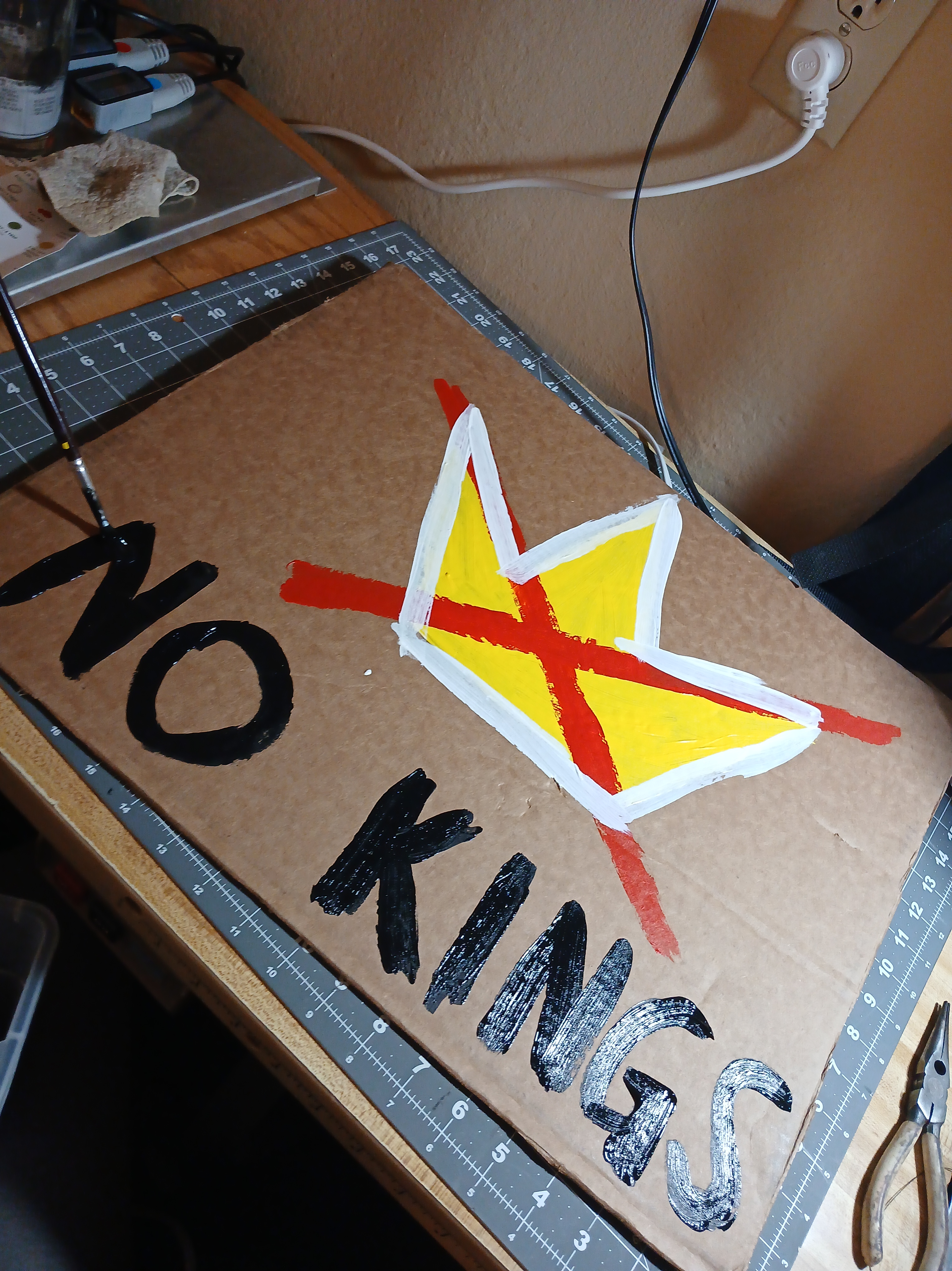
        • Taking action is a form of healing. Doing anything beyond paying attention to what is right in front of my face has been leading to spiraling despair lately, especially as the dystopian nightmare is getting closer and closer to home. So, I’m getting active. I got out my paints in preparation to participate in democracy this weekend. I hope to see some of you out there! 

Again, I’m so grateful to be healthy(ish) 10 months out from diagnosis, but the reality is, two more of my classmates from the Dunlap High School class of 1995 died this year of cancer. My best bud Missy, died 2 years ago from the same exact cancer that I have, so far I know two of us from that class that have survived…but there are so many people I don’t know about. Most people aren’t public about their health problems. Does anyone know of a study going on in Central Illinois about the massive number of cancer cases happening in young people? Other than those already listed, Missy lost her first husband to cancer, another friend’s husband died of cancer, another friend’s sister and brother-in-law died of cancer… all were younger than I am now. Was it the spraying of alfalfa and corn fields? Was it radon in the ground? Was it air pollution? Anyone? I know, I know, we’ll never know for sure because the poison is coming from all around us all the time. It’s everywere. Even newborn babies have microplastics in their bodies

A woman I’ve been following for some time now just announced her recent cancer diagnosis. Jen Gurecki has stage 2 breast cancer and has been a hard charger in the outdoor industry for years. I’ve purchased several things from the ski and snowboard company she started, Coalition Snow, and even bought a basket from Zawadisha, a Kenyan-based social enterprise she started whose mission is to provide small loans to rural Kenyan women to help finance their livelihoods. She is sharing her cancer journey over on her blog Redefining Radical. You can also donate to her Go Fund Me here.

Thank you for reading to the end, you rock!


Since the commenting has been so buggy lately on this website and an upgrade would be very expensive, I’ve decided to share these posts on my new Substack where commenting will be much easier. So head over there if you want to leave me a message. Note: My substack is free, I am not accepting payments at this time, so feel free to choose “no pledge”.
Moving Forward

Moving forward is the theme of the year, my next years, my foreseeable future. It always has been, but sometimes you need a big event, like almost dying – but not, to wake you up to the day-to-day reality of what it means to be healthy and alive. The moving forward theme is very convenient for a thru-hiker, especially me, as I’ve had a very deliberate and physical shift from hiker me to writer me since coming home from the Camino. 

I’ve turned the office where I built and ran my long-distance trail consulting business into my writing studio. I moved all my hiking and business books out, and my writing books in. I obtained a new cozy rocking chair to read in, and finally transitioned my trusty cancer cart that would move around the house with me into a bookshelf that now houses all of my medications, the books you all have sent me (there are still so many I have left to read!), and notecards.

Why do this? Because I’ve decided that I am writing a book next. That is my forward, and I’m very excited about it. Yes, I do want to create more Camino-style hiking opportunities in the States. Yes, I plan to continue to explore and adventure without a backpack until the day when I can start putting weight on these shoulders of mine, but I decided that I will be making decisions for the short-term me for now. I will transition back to the business of hiking phase once I’m certain that I’ll be around in 5 years to work on a 5-year plan. 

I have always wanted to write a book. When I was a kid, I wanted to be an author. Others want to be astronauts or doctors, and I wanted to be a writer. I talked about it and thought about it endlessly. I specifically remember designing the cover (in crayon of course) for one of my early books, named “A Story Within a Story,” but did I actually write it? I don’t recall, but I do remember thinking I could write anything if I really wanted to. 

I think I wanted to be an author so bad because I love books. Love them. Growing up, I read books like there was no tomorrow. Now that I know what no tomorrow really feels like, the metaphor holds up. Reading was and always has been a desperate thing. I would gulp down words as if they might disappear from the page. I wanted to read them all right now. Even today. The feeling I have of walking into a library or Barnes and Noble has always been one of longing and regret. There is no way I can read everything. 

I think my desire to consume words has always really been about the desire for adventure (adventure with a side of escapism). Hmmm, escapism….Zogore in Burkina Faso comes to mind. After college, I got what I asked for. The adventure of living in West Africa for my two-year Peace Corps service was completely overwhelming at times, and I read through my bewilderment and frequent existential crises. I dealt with the reality of being the first foreigner, not even the first Peace Corps volunteer, to live in that dusty and dry sub-Saharan village by escaping into my books. Hundreds of books. Note: I learned to adjust to the rhythm of it after the first year…there is something to the idea that deep time in a place softens you up to accept its imprint on your person. 

Since I started reading, I’ve been ingesting all of these stories and sagas, and those words have been sifting and percolating. And it turns out, I had been writing the whole time…just not books. From English class haikus in grade school to my dissertation in grad school: The Eco Interplay Ethic, I wrote a lot. But it took on another dimension when I started hiking.

When I started hiking, I knew I wanted to keep a daily journal, so my nightly scribbles on the Appalachian Trail in 2002 became part of my daily routine. I have no idea where that journal ended up, but I transformed my written journals into digital ones on my next few thru-hikes, including the West Highland Way, Pacific Crest Trail, Colorado Trail, Arizona Trail and more. Then over the last decade, as cell phones hit the trail, I’ve been typing with my thumbs on the 12 different long-distance hikes I’ve done since then…that’s about 12,000 miles of mornings. Early mornings became my witching hour. Early mornings are when my thoughts are most crisp, and even after sipping on the first dregs of my hot coffee in my sleeping bag, the night clings on just enough to bring some of its poetry back into the world.

Writing a book is a much bigger task than writing every day for 5 months on a trail (a la PCT or CDT). How do I start? I guess by writing every day for five months, and then five months more, and another five on top of that. Maybe I’ve started with this blog post.

Over the last month or so I started by reading about writing. (Can I give myself a self-directed MFA?) I want to study the craft. The structure. To learn how to weave different elements together in something as gigantic as a book. Like John McPhee says in On the Writing Process, start at an exciting part and circle back around (Note: revisit his structure in the story about the canoe and a bear). Add a little humor like Stephen King does in On Writing. Do the daily writing prompts like Suleika Jaouad does in The Book of Alchemy, and follow the 12-week program like Julia Cameron suggests in The Artist’s Way.

Of course there is no one way. I could just start writing.

But up next I’m going to take a workshop with Cheryl Strayed this weekend who wrote Wild (you know, the PCT book that wasn’t really about hiking the PCT). She rented a tiny house at the base of Hart Mountain National Antelope Refuge (along the Oregon Desert Trail!) to write her book. I figure it would be silly to NOT take her workshop. 

Then I’m going to the Central Oregon Writer’s Guide Conference in Bend. And after that? Maybe take a masterclass, maybe look into some residencies, maybe start on a quest to find a room with a view where I can go to for a week or two at a time, take in the landscape, go on walks, and write this thing. (If you have any ideas of cheap places I could rent, spots I could park the camper, or people who need house sitters, let me know!)

What is one of the most important elements of becoming the writer I’ve always wanted to become? Time. I have the time. I need to keep reminding myself of this because I’ve been feeling pressure to start thinking about work (Note: this is my own pressure, it’s not coming from any of you). Writing is work, right? If I’m not going to die immediately, I should be working, right? I’m fighting with myself there. Why does existence have to be productive? The gift my friends and family and the disability social safety net have given me this year is the permission and cushion of time to heal. To get better. Working doesn’t necessarily have to be part of that equation, but it also gives me a reason to be…especially when the reason is writing to process this new life I find myself living. 

Work also brings up the question of: “how do I make decisions now?” As I mentioned earlier in the blog, until I can be more confident of being around at the end of a 5-year plan, I’m not going to work on a 5-year plan. I’m going to work right now. I’m going to work on the immediate future. It’s tough, though, when I got the scan showing me I didn’t have any active cancer this summer, I suddenly could see a longer life… so does that mean I start saving for retirement again? Can I even entertain the possibility of retiring? All the while, I still need to make it to 5 years…and the odds aren’t quite in my favor, but then again, I’ve always excelled at exceeding the odds and have had good luck trusting the world. 

I don’t know the answer friends. I guess I’ll keep going forward and find out.


Since the commenting has been so buggy lately on this website and an upgrade would be very expensive, I’ve decided to share these posts on my new Substack where commenting will be much easier. So head over there if you want to leave me a message. Note: My substack is free, I am not accepting payments at this time, so feel free to choose “no pledge”.