
Last week’s chemo infusion was pushed back to this week to give my body a chance to recover from the rib radiation and for my new mutation med kick in, so I have a chemical drip-line to look forward to today. As I keep telling people, the chemo is so mild! Really, it is. The cocktail of drugs that are pumped into my port are so dialed in that I shouldn’t lose any hair, don’t really get sick (fingers crossed), and don’t get my insides torched along with the tumors.
I can’t remember if I told you about the port… it’s a small device that was surgically implanted in my chest about a month ago…it connects to a vein on the right side of my chest – above my lung but below the c-collar, and is used to draw blood and give chemo infusions without needing to go in through my arm vein. It will probably remain in place for the rest of this year(s)? There is a visible bump under my skin on my chest…tank top season this year is going to be lit!
So yes, the big item on my agenda today is chemo, then I’ll take my daily walk.
I’m up to a 45-minute walk! I can walk 45 minutes before my right hip starts hurting. There is so much going on in my right hip that my PT and I aren’t sure if the pain I am feeling is muscle or joint, tumor or not, so I’m doing a combo of stretching and strengthening to help rehabilitate that side while I try to gain back some semblance of my strength. This strength-building is going to take a while. I realized the other day that I’ve been in this compromised state for six months now. Six months! That’s half a year that I haven’t been able to go about life as normal. It really does feel like a time warp because there is no way I would have told you that I’ve been suffering from my injuries and this cancer, for that long. Time flies when you are in denial?
I’m also getting into the doldrums of the between treatment days. I binged the entire first season of Hacks yesterday. It didn’t feel great to stay in bed most of the day in front of HBO Max, but it also kind of did. I can see where it will be easy to slip into binge mode this year. I can be quite the sloth when I want to, and often feel there are two sides to me (I am a Gemini after all) duking it out…the extremely motivated side vs. the extreme sloth side. It’s almost as if these two sides have to balance each other out… I can be so incredibly on, so productive, so task and goal-oriented that the other side of the coin almost has to be a complete shut-down, reset, and veg mode. I seem to have two speeds. 120% and 3%. Is that such a bad thing? I guess it’s been working for me this far… let’s see how it shakes out in this cancer year.
These look-backs into pieces and slices of my past are almost all look-backs to the 120% of me, the other periods aren’t dramatic enough to have whole chunks of time worth reflecting on, maybe that’s why it works? There is moderation?
But today I think I’ll go back to 2003 and grad school. I’m doing a decent job of filling in the spaces for many of the other phases of life. We have:
- College and Peace Corps
- Wisconsin and Washington DC
- Appalachian Trail (so much more to say)
- Grad School (see below!)
- Portland and PCT
- Durango and Trail Crew
- Bend and Wilderness Therapy (these next chapters haven’t been explored yet)
- Art & Publishing and hiking as career
- Professional Hiking, the CDT and beyond…or the last 10 years
Grad School
What next? was one of the main questions I asked myself after returning from Burkina Faso and hiking the Appalachian Trail.
What next? I asked myself as I was in Washington DC interning at the Smithsonian.
What next?
Well, grad school seemed like the next logical step at this point.
I was exploring a career in museums at the time and grad school was almost a pre-requisite into that career choice. In DC I was surrounded by extremely educated people, and I’ve always been attracted to the school vibe. Most likely, my love of books goes hand in hand with my love of education, gorgeous college campuses, and libraries. Higher ed has always had a great allure and romanticism to it….and having grown up on college campuses (my dad worked at UW Stevens Point and then Bradley University) certainly played into that.
I wanted to go back to school. I was excited to go back to school.
So what does one study when they want to work in a museum? I had decided on museum exhibition design because I could combine my love of design, experiential learning, three-dimensional spaces, and education into creating exhibits that people could walk through, interact with, learn from, and engage with. I was very drawn to multi-sensory museum exhibits at the time, and the great thing about the Smithsonian museums was that they were free. I could pop into one of them and walk through for an hour, sit in one exhibit hall, or visit one corner and not feel like I had to spend all day because I had just dropped $30 on the entry fee. I fed my brain regularly on museum exhibits, and those trips all went into the big jumble of experiences that fed into my grad school applications.
Where would I even go? When researching master’s degree programs for museum exhibition design, I found that there weren’t many explicitly designed for my interests. That wasn’t a huge problem because I have lots of experience learning around a thing to get at the thing, and figured I’d need to piece together different aspects of study to get at my chosen field. The University of the Arts in Philadelphia did have a museum exhibition design program though, so that went on the list. Other ones I ended up applying to were Museum Studies at JFK University in San Francisco, the University of Washington Museum Studies program in Seattle, and the Design Futures program Goldsmiths College in London.
JFK University isn’t even around anymore…it closed in 2020, so I guess it’s good I didn’t go there? The museum studies program at U of W ended up being the only program I didn’t get into, which is just as well because I would have had to cobble together that degree to make it into what I wanted. Then there was the University of the Arts. I took a trip up to Philly to tour and interview at the school back in 2003. (This is another school that closed!!! Just last year in fact. That sucks). Had I chosen this program it would have explicitly involved designing museum exhibits, which seemed very practical at the time. On my visit I met many students in the program and had great fun looking at some of their dioramas of exhibits they were putting together (man, I love a good diorama!). University of the Arts would have been the most plug-and-play school choice for me; the program was designed to create exhibition designers, and the course work was very clearly created to prepare me solidly for that field. The Museum of the Arts was at the top of the list, but the exotic, multi-disciplinary, and non-traditional choice of grad school in London was pulling at me from the background. Museum of the Arts would have been a solid choice, and I was accepted into the program, but the expense gave me pause. It would have cost about $50,000 a year (for two years) to go to school there, and sure, I could take out loans for that amount (I was very lucky to get out of undergrad without any student loans), so it was clear sailing for me and the debt I would be taking on, but $100,000 grand for a fairly low-paying field of study did give me pause. (Side note; money has never really given me pause. I’ve never really had it, or thought much about it…money has never stopped me from doing what I’ve wanted to do, and I’ve always made enough to squeak by with my chosen lifestyle, but for some reason this debt did give me pause).
There were other reasons that London rose to the top of the list. There was a boy. A boy at the time who was going to grad school at London School of Economics. If I were to go to grad school in London, we could be in the same city and see what was what between us. So yes, the boy was a big factor at play when deciding where to go to school…we had in fact gone to the same high school and joined Peace Corps at the same time too. He served in Guinea, West Africa at the same time I was in Burkina Faso, and we reconnected back in Peoria after both of us had returned from our two years of mind-melting mid-west counter cultural experiences.
What else did London have going for it? Well the program I decided to apply for was called Design Futures and was a very interdisciplinary and utopian look at how good design could help make the world a better place, which were ultimately my operating principals at the time: making the world a better place. The Design Futures program was solidly above and beyond all the others for its aspirational goals. It was based out of Goldsmiths College, which was the University of London’s creative college, and best of all? I could use federal loans to go to school overseas. I would be in school for about a year and a half, continually, rather than the two years with summer off schedule in the US, and it would be cheaper (cheaper!) for me to go to school there. The only drawback was that the degree wouldn’t necessarily line up with a degree program in the states. Design Futures was non-traditional enough that it might not be recognized as a graduate program in the US system, but, as I rarely subscribe to the system, that aspect really didn’t matter to me at all.
Design Futures was a deep dive into sustainability, into deep ecology and theory, and heavily based in reading and writing. Each of us in the program chose our own method of design that we wanted to apply our thinking too. I chose museum exhibition design, while others in my class were furniture designers, textile designers, graphic designers, architects, etc. We were quite the eclectic group from all over the world. I loved that aspect. I was the only American; other students came from Norway, Spain, Japan, China, Korea, the Netherlands, the UK, and beyond. In fact, I was often the only American around during those few years, and I enjoyed it.
Shortly after arriving in London in August of 2003, the boy and I broke up, so I didn’t have any connections when I was trying to find my footing. It was a discombobulating time, but it was also a sink or swim time. I eventually swam, but it did take a while.
Soon after arriving I found a room to rent in a group house on Coldharbour Lane, a notorious street in SE London, and threw myself into becoming a Londoner for the next while. I loved my flatmates. Again, I was the only American, and lived with a creative and electric bunch: Franka and Janette were from Germany…Franka was an architect and Jenette was a fashion designer. Jesse was a Brit and was an illustrator, and David was from New Zealand and played music among various other pursuits. There were other housemates who came and went during my time there…they were all fun and eccentric in their own ways, and we had great times together.
My house was about three miles from campus, so I would often walk to classes. It took about the same amount of time to walk to school as it did to take the bus. At this time I was very very poor. Like count my pennies, I could only afford one-beer-a-week poor. Taking out loans and eeking my way in the expensive city of London became its own challenge, but fortunately my parents helped me out with some small loans of their own, and I also started working, which helped me eventually work up to a two-pints-of-beer-a-week allowance. Being poor in London wasn’t all that bad. I couldn’t afford to take the tube anywhere and instead walked the city. I was a hiker by that point anyway, and walking everywhere was natural. It was my entertainment too. It took me a while to make friendships while I was there, but I had my walking. On weekends I would walk to new destinations in the city, go to museums, visit a cafe or two, and always had my eye on free entertainment in the city. There was always music or street fairs, and being a student also helped with discounted tickets to shows and such.
My time in London was kind of a struggle, but a good struggle. Like I said before, a time of sink or swim, and after treading water for a bit, I swam.
So school, what was that about? From the start my professor, John Wood, was feeding us ideas around designing utopias and creating new social and design structures that would foster community and societal order. It was brilliant. We looked to Buckminster Fuller and many philosophers. The schooling was incredibly different than what I was used to in the states. We would have one full day of lectures a week, and the rest of the time was ours. We had four essays to write during the length of the course with a dissertation at the end. That was it! We had to read and think and apply those principals to our chosen design disciplines. It was much like the Peace Corps in that we were left to our own devices to make of it what we could.
I am really good at writing papers, and found I was well-suited to the structure. I spent many hours in the library, and many hours visiting different museums around London. I even had a short stint, not really an internship, at the London Portrait Gallery. There was a relationship of sorts with the museum I had interned at in DC, and I pulled on those connections to get me a gig at the London museum. I spent a few days with their staff behind the scenes, but after I almost cut my finger off with an Exacto knife on one of the first days I was there, the gig didn’t really turn into much. I think they thought I was too much of a liability…no matter though, much like the DC museums, many of the London museums were free so I could come and go frequently and pop into exhibits that I was drawn to.
I was very interested in multi-sensory exhibit experiences….and I’ll stress experiences here. I thought the more senses an exhibition could entice, the richer and more evocitiave the exhibition experience could be. At the time the Tate Modern had a wonderful exhibit by Olafur Eliasson that I would visit again and again. It was called the Weather Project, and the old turbine hall was turned into another world. The ceiling had been plastered with mirrors, and on one end half of a glowing sun appeared against the mirror, evoking a sunset atmosphere. Clouds of moisture would be puffed out from time to time, and the experience was so immersive that people would lay down on the floor and bask in the sun. It was an experiential exhibition to the core, and I loved it.
So what came out of my time there? Ultimately I decided that I wanted to take the museum out of the museum, and my dissertation was all about developing an “eco-interplay ethic” where museums could be a safe place to study and play with ideas, many around sustainability, and give visitors a chance to see and interact with different sciences and disciplines side by side. It was about moving away from an object-based museum to an experience-based museum where an object could come alive with more interpretation around its holistic story….a story that included people, place, setting, and purpose.
I still have the program from our year-end degree show which encapsulats all the thinking we were doing that year. The show was called “Yet/Still to Come” and may do a better job at illustrating what I was doing during this time than my words above do.


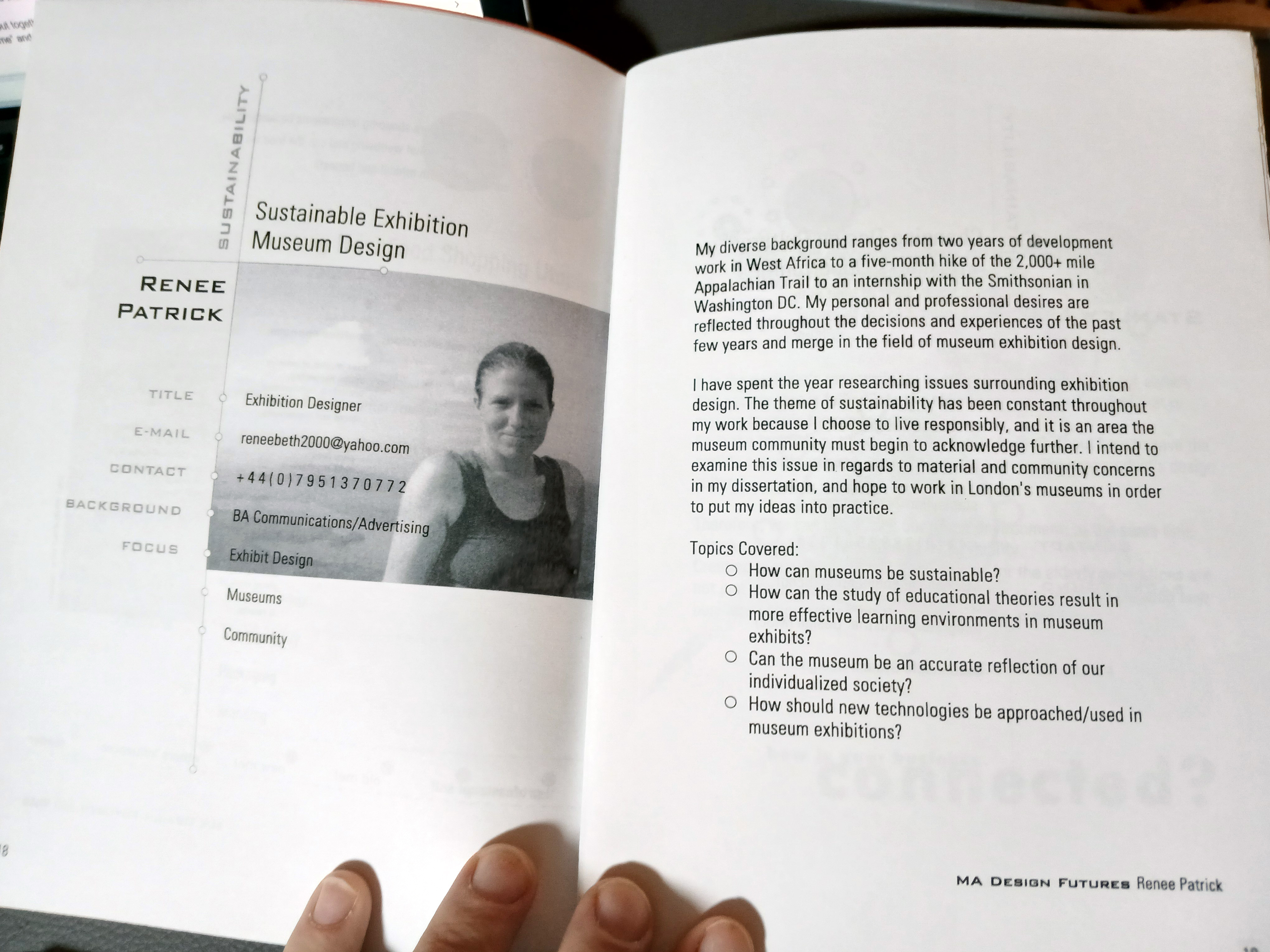
At the end of the Design Futures program, I wanted to stay in London and work in a UK museum, but none of my job applications went anywhere, and I ran out the time on my student visa, but not before making a wonderful trip to Norway with one of my classmates Elizabeth to visit her home country and spend some time in Oslo and the country-side. I returned to Illinois in October 2004 and made a quick turnaround time to order to move to Oregon that November. That means I became an Oregonian just over 20 years ago! Does that mean I’m an Oregonian, or do you have to be born here??
How has that time influenced my work today? Well, like I said before, after grad school I moved to Oregon and couldn’t find a job in museums, so hiked the PCT in 2006. From there on the desire to live and work outside has become more of a framing reference for ideas and aspirations, but Design Futures still lives on….
It was quite a jolt years later when I realized after I got the job to establish the Oregon Desert Trail that I finally had my museum exhibit. I had created an opportunity where I was curating a three-dimensional multi-sensory experience in a thru-hike so that a hiker could immerse themselves in place, learn about the history, ecology, flora, fauna, conservation opportunities, public land issues, all the while walking through one of the most remote landscapes left in the US.
THIS was my dissertation.
THIS was me putting my grad school experience into practice.
This is the foundation of my business today.
Through the full-bodied, holistic, experiential experience of thru-hiking a trail and creating the resources and experiences for hikers to learn and interact with, I am creating a better world. Good design can change the world, and by designing a hiking experience with the goal of creating a more engaged and informed hiker, I am putting Design Futures into practice.
So yes, grad school has been an important phase of my life and continues to influence everything I do today. Living in a world of ideas for a while can have practical implications, but I wonder if ideas don’t always get enough time and space for thoughts to fully develop…we need to give ourselves and each other the time and space to think, dream, read, write, be, and explore. I will always go to bat for a liberal arts education…it helped make me who I am today, and a realm of study where we can apply different principles to many of life’s disciplines is invaluable.
So with that I’ll close my grad school chapter and retun to the land of cancer to think and read and look at this time of pause in my life as another experience of playing with space and time…perhaps I’ll come out the other end of this nebulous cancer year with a bunch of new ideas and ways to apply my thinking to the trails community, or maybe I’ll fully embrace my sloth state to binge watch a bunch of TV and read a ton of books. Regardless, I know the inputs, and conversations, and musings of this year will go into the big stew–pot of my experiences and will somehow influence future me…the how is yet to be determined.

 She-ra Hikes
Hi Renee, I think you should send the last part of this update (not sure what to call these emails) to your professor in London. The part that starts with “It was quite a jolt….” If he is still around I know that if I were him I would love to hear how you are using your education. My father sent his three children to have aptitude testing done. It was interesting but I was out of college and was not at all inclined to go back. Years and years later I found the results of the testing and realized that I had incorporated all my strengths and main interests in my life anyway. I am hoping I told my father that but I don’t really think I did. A lost opportunity to tell him something I know he would have loved to hear and a way to say ’thank you.’ Keep up the writing even if you are in the sloth stage. Jancie
>
LikeLiked by 1 person
Thank you Janice, I think I will!
LikeLike
lovely synopsis
LikeLiked by 1 person
Now I know a lot about a port. Medical science is just getting better and better. Good luck today! -Vic
LikeLiked by 1 person
🙌
LikeLike
Thanks for being the inspirati
LikeLiked by 1 person
Your updates and “ travelog” through time of your life before your current businesses are truly inspiring. Your blog/journal
LikeLiked by 1 person