More Blue Mountains Trail

Did you miss our group presentation about the Blue Mountains Trail last week? Watch it here:

The next one is coming up tonight with the Oregon Outdoor Alliance. This will be a different type of presentation, more of a panel discussion where we cover such issues like:  How do you think a long-distance trail is uniquely poised to make the connection between recreation and conservation?

I’ve had a long involvement in the Oregon Outdoor Alliance. In 2014 I joined the steering committee as the group was just getting started with some local Bend outdoor industry folks like Van Schoessler, Pam Stevenson, Gary Bracelin & Rob Little. I offered to design the first logos and website, and served on the board until a few years ago.

So join us! Should be a good time.


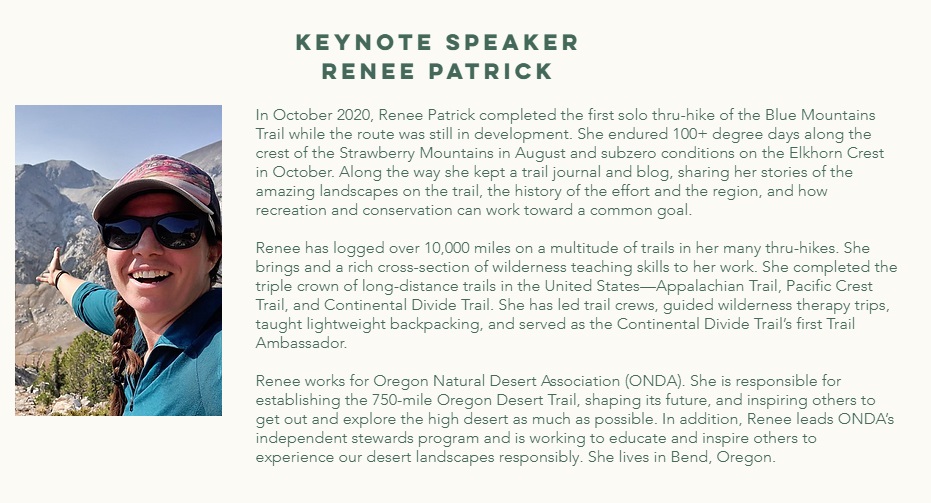
Next up: I’ll be giving the keynote presentation at the Greater Hells Canyon Council’s annual fundraiser: Hellraiser on May 8. This is a virtual event, and will focus on all the good work we’ve been doing to establish the Blue Mountains Trail.

Look for some great auction items you can bid on (and help us raise money to make the Blue Mountains Trail a reality)…there just might be an opportunity to bid on a hike with me on the BMT this fall…just saying!

More to come…the Blue Mountains Trail is taking off…there is lots of work to do, but lots of ways to get engaged, so sign up for the May 8 event and learn about all the ideas and plans we have in store.

Find Comfort in Cold-Weather Hiking

Can you enjoy the sunrise if you are cold, wet, and hypothermic? Can you enjoy the sunrise if you are ensconced in layers of warm down with a mug of hot coffee in your hands? Enjoyment and delight in nature is so much easier if you are comfortable.

Read more about my cold-weather hiking tips on this blog post I wrote for Katabatic Gear:


Find Comfort in Cold-Weather Hiking

Find Comfort in Cold-Weather Hiking

By Renee “She-ra” Patrick, Oregon Desert Trail Coordinator

Can you enjoy the sunrise if you are cold, wet, and hypothermic? Can you enjoy the sunrise if you are ensconced in layers of warm down with a mug of hot coffee in your hands? Enjoyment and delight in nature is so much easier if you are comfortable.

I’ve spent many years as an outdoor professional hiking and adventuring in cold and wet weather, and have come to love the time I spend outside, even in the worst weather. Why? Because I’ve slowly evolved my systems so that I can be comfortable in just about any context. In fact, I think more folks will come to outdoor pursuits if we keep comfort at the top of the to-do list. 

I outlined my “comfort in the cold” strategy for a month-long Blue Mountains Trail thru-hike in October of 2020. During the hike, temperatures ranged from 70 to 5 degrees. My general rule of thumb was to plan for the worst conditions I could imagine; if the worst never came I’d still be comfortable…or if the worst came every day of the trip, I would still be able to continue.

Shelter

  • Freestanding tent – I set out to hike almost 500 miles in a month, and knew that October would bring short daylight hours. Most days I would be hiking until dark and possibly pitching my shelter on snow or frozen ground. If I was cold and wet I would need to get into my shelter fast and change clothes to prevent hypothermia, so I choose to bring a free-standing double-walled shelter. A double-walled shelter, even though it is heavier, can save you and your gear from becoming soaked (have you ever brushed the inside of a single-walled tent when it’s wet?). I also used my tyvek groundsheet on the inside of the tent as an extra moisture barrier because I knew my body heat would melt the snow or ground beneath me.
  • Two sleeping pads – I love sleeping on air and have used inflatable pads for years in all types of weather. In the winter hikers need to be aware of the law of thermal conduction. Simply stated, if you sleep on the ground and the ground is colder than you are, the ground will suck the warmth from your body until you are the same temperature as the ground. So to keep the air in my sleeping pad from becoming the same temperature as the ground, I take a closed-cell foam sleeping pad to use beneath the inflatable sleeping pad. It’s amazing how much warmer even an eighth-inch piece of foam will make you.
  • Shelter storage – Your tent will get frosty at night, primarily from your breath freezing on the inside of the shelter. Bring a separate waterproof stuff sack for a wet tent (if you are storing the tent in your pack) or keep it on the outside of your pack. You can take it out to dry during the day, but realize it might not get warm or sunny enough for a drying session, so plan to manage the cold and wet as if you won’t get the opportunity.

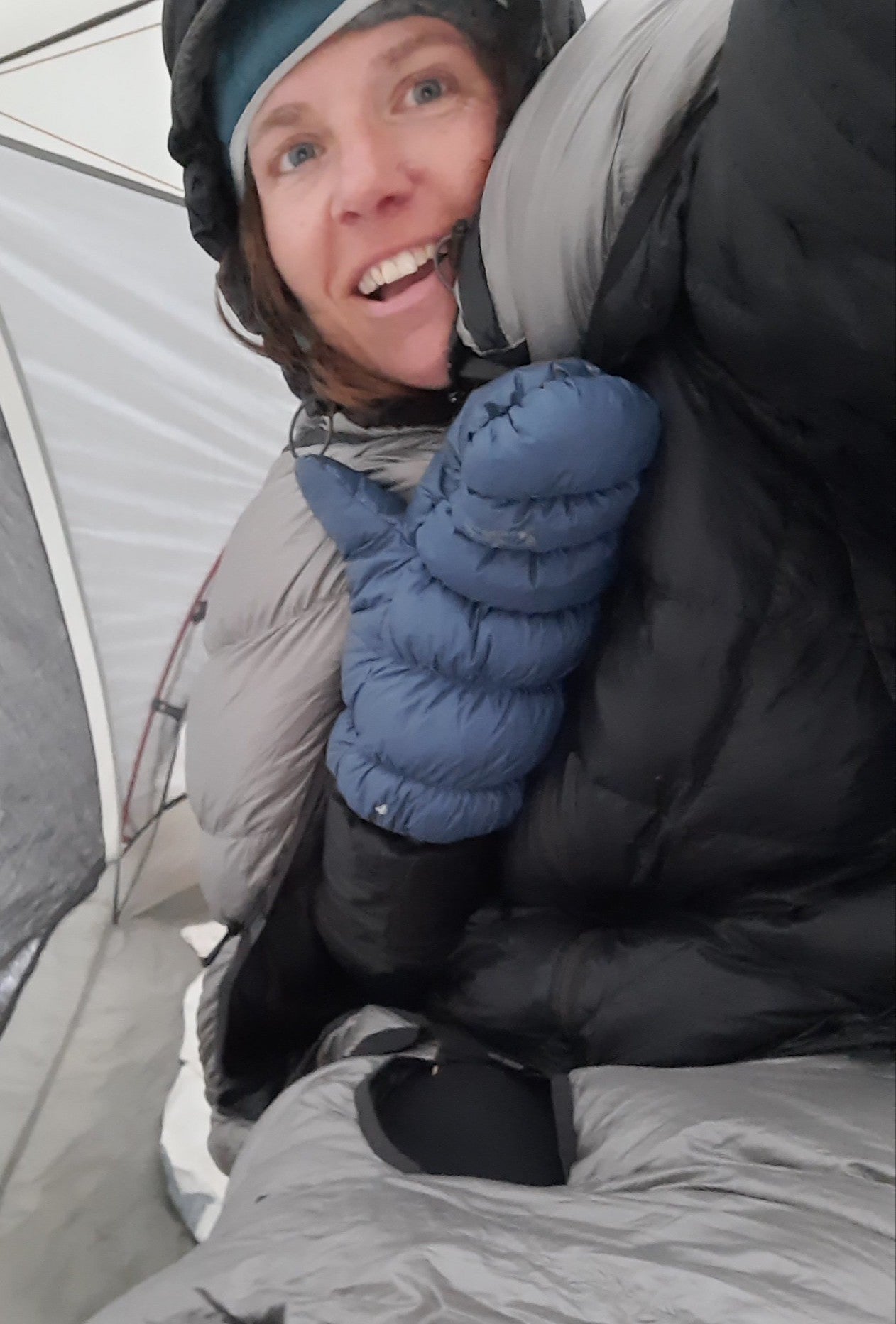
I learned to wear my Katabatic quilt as a cape to stay warm while cooking dinner. Photo by Renee Patrick

Sleep system

  • Down booties – Warm and dry down is the lightest and warmest insulation available, and wearing down booties at night does wonders to keep my appendages toasty warm even in the coldest temps.
  • Sleeping quilt/bag – Take a quilt or sleeping bag that matches or is rated for colder temps than you expect to encounter. This was the first time I used a cold-weather quilt, and Katabatic’s version was amazing. I discovered on one very cold night that I could turn the quilt around, keep my legs in the bottom half, and wear the top as a cape. I buttoned the quilt around my neck, which left my arms free to cook and eat. So cozy! And during the night I slept with my hooded fleece layer and my hooded down coat on so that I had three layers of warmth on my head: hat, fleece hood, down hood. Yes, even with a hoodless quilt you can keep your head warm, use those hoods!
  • Fill that empty space – if you find your sleeping quilt has a ton of extra space in it, try to fill that space with extra gear. Down works when your body heats the layer of air between you and the down. The more air your body needs to heat, the longer that space will take to get warm.
  • Don’t wear wind-blocking/waterproof layers to bed– If you block your body’s ability to warm the air in the quilt, you will not get warm, so take those raincoats, wind coats, and rain pants off. They will only prevent you from getting as warm as you could have.
  • Keep cold-vulnerable items warm at night – Electronics, medications (my epi pen), and wet wipes all come into the quilt with me at night. Think through all the things in your pack that could get damaged (or unusable) due to the cold, and throw them in your quilt with you.
  • Damp in the bag– It’s true that you can sleep with damp clothing and dry it out overnight with your body heat, but there are limits. Simply tossing your wet socks into the bottom of your bag might not do the trick if they get wadded up and never are exposed to your body heat. So I put things like mittens and socks next to my body in my long johns. Seriously. It’s a little cold at first, but they are toasty dry by morning.
  • Wear damp clothes to bed – Take the previous suggestion to the next level. The quickest way to dry a damp shirt is to wear it. Granted, this step should not be taken until you yourself are warm. Once your body has warmed up, you have eaten, and that internal furnace is stoked, take a deep breath and put that wet shirt on. It will suck, it will feel uncomfortable, but by morning your body will have dried it.
  • Hot water bottle– You can take a hot water bottle to bed if you have the right kind of bottle (I’ve only been comfortable doing this with a Nalgene). Pour some boiling water into your bottle and throw it to the bottom of your sleeping bag, or cuddle it.

Read the rest over on the Katabatic website

Exploring Oregon’s Outback One Step at a Time

Our weekly newspaper in Bend featured the Oregon Desert Trail last week! Read all about it here:


The Oregon Desert Trail connects people to place

By Damian Fagan in The Source Weekly

The Oregon Desert Trail, better known as the ODT, is a 751.7-route that traverses eastern Oregon, connecting the Badlands Wilderness to Lake Owyhee State Park. The trail slips through dense sagebrush steppe and ancient juniper forests, across lava flows and through canyons incised deep into an old land. There’s wild and wilderness and plenty of opportunities for solitude and solace.

“The story begins in 2010 when our former executive director Brent Fenty had the idea of connecting places where ONDA had been working in and to highlight some of the success such as the Badlands Wilderness and Steens Wilderness,” said Renee Patrick, Oregon Natural Desert Association program manager who oversees development and stewardship of the ODT. “In between those two areas, we have done a lot of conservation work and thought we could help people connect to this landscape through a trail or route and help them see these lands first hand.”

Descriptors such as the Oregon Outback, High Desert and Sagebrush Sea do justice to this desert landscape of sweeping vistas, rolling hills, fault-block escarpments and deep canyons.

As Patrick puts it, “You’ll see more pronghorn than people.” The concept of spending time exploring and getting to know this remote section of Oregon may be foreign to some more accustomed to exploring the Cascades, Oregon’s verdant spine. However, the desert landscape’s subtle beauty reveals itself to those who wander.

Author Ellen Waterston writes about living in and exploring the High Desert in “Walking the High Desert: Encounters with Rural America along the Oregon Desert Trail.” When asked about her experience, Waterston said, “The high desert is inscrutable at best, but during the winter especially so. I relish the palpable sense of all that’s brewing beneath the surface of the desert’s vast expanses. And while I’m waiting, nature puts on a show: hoarfrost exquisitely tracing the slimmest blade or branch, a coyote plowing its snout through the snow as it tries to rout a rodent out of hiding or pronghorn kicking up a wake of wintery glitter as they speed across an open savannah carpeted in white.”

The task of designing the route fell to Jeremy Fox, Patrick’s predecessor. He began the arduous task of sketching out the trail, utilizing existing resources such as trails, two-tracks, dirt and paved roads for most of the route. Private property and highly sensitive wildlife areas or habitats were skirted. Blank spots on the map were connected by cross-country travel; nearly 35% of the trail includes trailless sections where a hiker’s navigational skill will be challenged.

“Long-distance backpacking is not a traditional pastime in eastern Oregon in the desert,” said Patrick. “There’s a lot of curiosity and disbelief.” Patrick has worked hard at informing land and business owners about the trail that passes by their properties and towns. Now, landowners living in the outback have a different take for Patrick. “They don’t ask why; they tell me stories of hikers that have passed through—so it’s really rewarding to see that trail culture developing.”

Whitney LaRuffa hiked the ODT with a couple of friends in the fall of 2018. “I picked that trail because it’s a part of Oregon that I’ve visited and always wanted to see more of,” said LaRuffa, a seasoned long-distance trail hiker and vice-president of sales and marketing for Six Moon Design. “There was a true sense of adventure hiking the ODT compared to some of the more established long-distance trails that are more plug-and-play,” LaRuffa added.

For LaRuffa, it wasn’t just about being a thru hiker. “People we met along the way were all very friendly, making sure we had food and water and that we knew where we were going,” LaRuffa said. After his hike, LaRuffa spent time on an ONDA trail stewardship project, giving back to the area he had passed through.

Though the trail exists to hike in its entirety, day hiking or shorter overnighters are possible. ONDA provides excellent resources such as maps, GPS waypoints, information about water resources, and other trip-planning details on its website, along with information about the wildlife, geology and history of the region.

Central Oregon day hikers looking to go somewhere COVID-19 safe may enjoy exploring unique geologic features in the Christmas Valley and Fort Rock area or “the backside” Pine Mountain. ONDA also initiated the Badland Challenge to encourage exploration of over 50 miles of trails in the Badlands Wilderness, located just east of Bend, where the ODT starts or ends—depending upon your sense of direction.