I haven’t sent an update in a while, I think primarily because I’ve been sleeping. Until today that is! Here I am, up at 1:38am again. Yesterday I slept until 5:30am, the day before, 4 something. I’m going to have to learn to write these updates in the daylight if I keep sleeping like I have been. I know! Good problem to have!
But today when I woke feeling fairly rested at 1:38am, it seemed like a good time to get up and write.
My tiredness seems to come whenever I slow down now. If I sit long enough, no matter what time of day, I get sleepy and can close my eyes to the sweet darkness and drift away. Some days I have to rouse myself or I might sleep all day. It can be a struggle to get up, but when I do, I can be fully engaged and feel great. It’s just that sleep is always there for me now if I want it. What a difference!
Another big difference: my collar. I didn’t wear it at all yesterday! And I went on my longest walk to date! My legs are feeling it, though. I have the soreness that I used to get after all day with a pack on, and now I get it after a three-mile walk.
My rash is mostly gone now, but I have a nasty infection on both big toes. Again, another side effect of the tagresso. It’s not so painful that I can’t walk, but it’s uncomfortable and preventing me from starting to do some pool sessions, which I’m super eager to do. Our senior center here has a current pool, so will be great for walking. I had my last home-visit from the PT this week, I’ll start seeing a new one as an out-patient next week, that means going to their clinic for session. Hannah, my PT, encouraged me to start playing with a full range of motion in my arms, head, neck, and back….and I think that will be much easier to explore in the pool. My head has more movement, but I have a limited range of motion, so it will be another week or two before I start driving again. I need to be able to turn my head, and right now can only do so for a few inches on either side. My left is a bit more frozen than my right, but that tracks as all my neck and shoulder problems happened on the left side.
This is as almost normal as I’ve been in six months!
I can’t believe it’s been six months since I hurt myself – no, it’s actually seven! The first tweek of my intercostal muscles happened in early September, I was almost completely incapacitated for October and November, and December was the month of my diagnosis and surgery. In January I started chemo and was in a wheelchair, February was more of the same, and in March, I emerge. April will be more chemo but I will be focused on recovery.
I haven’t had a scan since early February, so I don’t know if all of this chemo, radiation, and medication is working, but the fact that I’m so much more mobile tells me something is happening. I’m eager to take another scan, maybe at the end of April or early May, and see how much cancer’s butt I kicked.
Pam gives me great hope. We walked yesterday, and I learned that she just had her one-year since cancer happened anniversary and is doing fablously. We talked on the walk, and the hard truth is that wiith our level of cancer, the kind that was caught late and has spread so far and wide, we will never really be in the clear. There is always the chance it will start growing again. What we have, though, is a mandate to live as cleanly and in tune with our bodies as we can. We will always need periodic scans for the rest of our lives, but she helped me see that instead of fearing the the scans, and fearing that they will show the cancer has come back, we can choose to see them as early warning signs, an early warning sign to start treatment at a much earlier stage than we experienced the first time around. It’s easier to treat if you find it early, and with scans every three months, that will likely be the case.
It’s also true that we have to accept a shortened life span….that our lives will most likely be shorter than if we hadn’t had our cancer turn on. I’m not sure yet how to process that. I choose to believe that I might live until 80 instead of 90. That it won’t be short as in soon short. We basically take our targeted cancer meds (tagresso for me) until it stops working. A few months? A year? 10 years? And then we take a different med for as long as that works, and so on. At least both of us have other meds to take. Pam’s mutation is different than mine, but she has something to fall back on should the med she is currently taking stop working.
She mentioned that the book, A Year to Live, has been helpful to read, and I will probably order it soon. I think this is a book for all of you, too. It “teaches us how to live each moment, each hour, each day mindfully–as if it were all that was left. On his deathbed, Socrates exhorted his followers to practice dying as the highest form of wisdom. Levine decided to live this way himself for a whole year, and now he shares with us how such immediacy radically changes our view of the world and forces us to examine our priorities. Most of us go to extraordinary lengths to ignore, laugh off, or deny the fact that we are going to die, but preparing for death is one of the most rational and rewarding acts of a lifetime. It is an exercise that gives us the opportunity to deal with unfinished business and enter into a new and vibrant relationship with life. Levine provides us with a year-long program of intensely practical strategies and powerful guided meditations to help with this work, so that whenever the ultimate moment does arrive for each of us, we will not feel that it has come too soon.”
What would happen to the world if we all examined our priorities and lived carpe diem? Lived each day to its fullest? If we were grateful for every day and the people in it? I know we would live in a different world. Maybe a kinder one?
All of this brings to mind wilderness therapy. Many parents who sent their children to us in a wilderness therapy program thought they might lose them, that without an extreme intervention like spending months in the desert, that their child might be gone, gone to depression, suicide, drugs, violence, hate, bad decisions… With such an extreme change of surroundings, that they may come to value life again.
And I think it works. Many people ask me if wilderness therapy works, and I think yes. Of course there are bad players and stories in the media about programs that mistreated the students and such, but that was not my experience. I think for every story of bad, there are 10, maybe 100 stories of good. I am still quite connected to my fellow wilderness therapy cohorts from 17 years ago. Wilderness therapy is what brought me to Bend after all, and in fact, it was my PCT friend Jack who encouraged me to think about it as a career option. He had started working for the company, Second Nature, in Utah, and when I was done with my trail crew year in Colorado in 2007, I returned to Portland (to my metal roofing winter) and applied to the Second Nature program based in Central Oregon.

Before I was offered a job, though, I had to go through a week of training and learn all about the program as if I was a student. If that doesn’t cultivate empathy for what a student will go through, I don’t know what will. I did my week of training in January of 2008 with three feet of snow on the ground. Talk about extremes! We had to hike through the snow (there was so much that we had to modify our original plans…there was just too much to hike to our usual spots in the desert), sleep under tarps, learn to bow-drill to have a fire, and were immersed in the world of using wilderness as an intervention in a kid’s life. After all, nature is the best teacher.
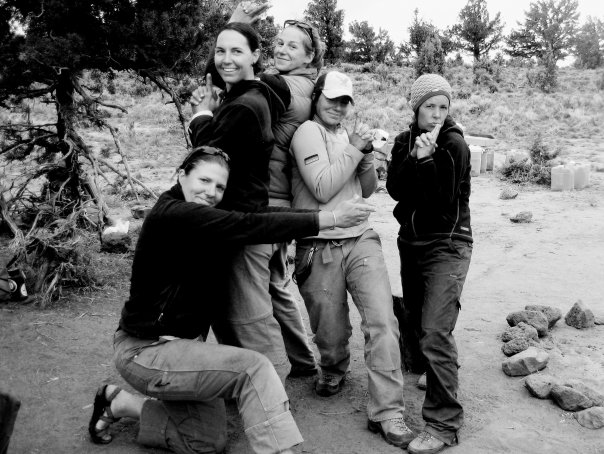
I survived our week of training in the snow and was offered the job. I returned in April to officially move to Bend, and fortunately ended up in a house filled with current and former Second Nature staff. My first years in Bend and in that house were fantastic. I lived between downtown and the Old Mill (the same neighborhood where I currently live), and my housemates were the best kind of people. Many of the women I lived with had finished their time with Second Nature and knew exactly what I was going through. Others were still working there but on opposite shifts from me. Second Nature split the staff into two different shifts. Our schedule started on a Tuesday, and we would work 8 days on, 6 days off. So I would go into work on a Tuesday morning (when I moved to Bend I didn’t have a car so would bike to base, often on studded bike tires if it was snowy) where we would receive training about some element of therapy, and then drive out to the field. The field was in the high desert…not too far from parts of the Oregon Desert Trail in fact! I was living in the desert before it was my job to usher hikers through the desert. Oregon’s desert features heavily in my life. When we arrived from our hour and a half drive, we met our groups of students (there were usually 3-4 different groups) and transitioned with the staff from the other shift. When we came in, we brought the staff treats, and they eagerly hovered around staff tree and stuffed down bagels with salmon and cream cheese, (that was a commen eighth-day treat…and wow does it taste good after a solid diet of rice and beans for a week!)
We would circle up and learn about how the previous week went, and then last week’s staff would be off for their week of freedom, and we would dig into the week with our group.
Like I said before, many of the kids were there because their lives weren’t working at home and their parents feared for them. Feared they might not be around much longer unless something extreme happened, and the Oregon desert was quite extreme. Some had never camped before, some had never seen snow before. Our program was year-round, so even in the coldest of cold, we were out there camping with our students. Of course, there were protocols for things like extreme cold and extreme heat, and all the students had to be medically cleared to come into the program. We were very vigilant of safety and health concerns and spent alot of time on health checks while we were there. A nurse would come out to the field every week, and we were trained to pay attention to any little thing (this is where the Wilderness First Responder training came into play). Each student was assigned a therapist, and what I thought was the great thing about our program was that the student’s parents were also in therapy with the same therapist every week. As field staff, we would help implement the therapy assignments for the week and overall just acted as solid role models – using appropriate communication and conflict mitigation techniques. We were on 24/7 for 8 days. We had to be the role model staff and keep our cool even when the students were not on their best behaviour.
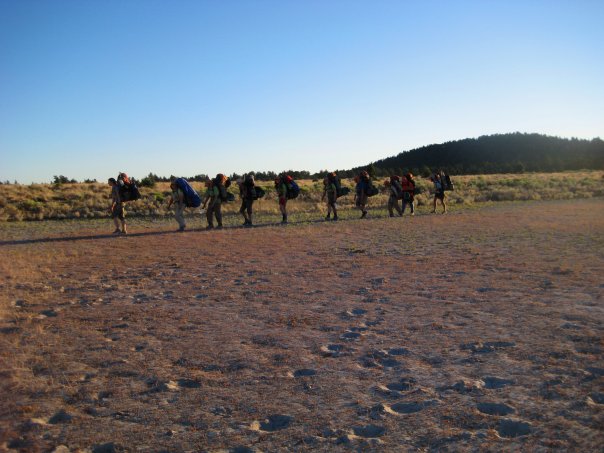
Nature was the intervention, and love of nature and hiking, and spending time outside was what I brought to my groups. We hiked a lot in the program; we hiked most days, and the students who were farthest along in the program learned to navigate with map and compass and we had them lead the hikes. Bow drilling was a core feature in our program, and when a student came in, much of their time was focused on learning how to bow-drill. We would harvest our bow drill sets from the desert, juniper branches made good bows, and the sage made great spindles, fire boards, and nests to blow our embers into flame. Of course, we as staff had to be able to bow drill and teach the students the craft, and often the frustration of learning to make fire was a good way to learn how a student dealt with hard things and then we processed those emotions together. I had my own outbursts when I was learning, and it took weeks and weeks before I could confidently make fire on demand, and wow, that feeling when you could…it was powerful!
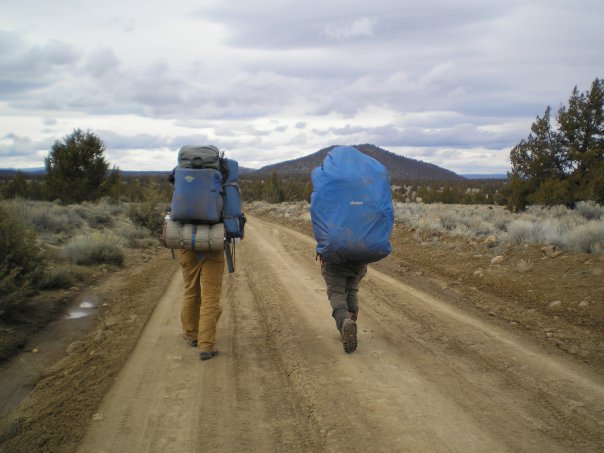
I won’t go into many other details as there were certain confidentiality pieces to the job, but I did see change in the kids. They would spend months with us, usually 3 months, and slowly and surely they would go from seeing the desert as a prison to seeing the desert as a living place of wonder. I would smile when they would draw our attention to the sunset, chuckle when we saw a mountain blue-bird hovering over the sagebrush only to dive into it to catch a snack, and beam with pride when a student led us with map and compass to a far-away camp – all cross country hiking in the juniper and sagebrush sea. We usually didn’t know what happened to our students when they finished our program. Often, wilderness therapy was just one step in their journey towards a healthy adult life, and they needed to focus on the next step, and we needed to focus on the new students.

But I don’t think I will ever have a more stressful and difficult job than wilderness therapy. Nothing could be harder than being in charge of 10 students for a week, being in charge of their mental and physical well-being in the middle of the desert. I would return home absolutely drained (after having devoured our bagels with salmon and cream cheese at staff tree) to just collapse in the shower and wash a week of dirt and campfire off (it was often a bower = beer in the shower, for ultimate reintegration). I would collapse just long enough to change and go out for beers with the rest of my team to process the week, eat good food, and tell stories from the week. Wilderness therapy was another very intense experience, much like Peace Corps and thru-hiking…and very bonding. Like I said, many of the other staff I worked with are still friends today, and we all marvel at the shenanigans and wild stories from our time out there. Like the tree that was hit by lightening in camp, or the coyote that pooped on our food drop; the intense cold we would have to endure in the winter, or the endless games of dogs (hacky sack) we played in the dirt. Those were some great times, some trying times, some exhilarating times, and I lasted two years. The average span of a field staff in a wilderness therapy program at the time was 6 months, and I lasted two years. I went on to work for the publishing company in town next, and even when I was at my busiest and cranking out a 40-page art magazine a month, it was never more stressful than dealing with a sick student at midnight in the desert. There can never be anything more stressful than being in charge of a person’s life, it just didn’t compare.
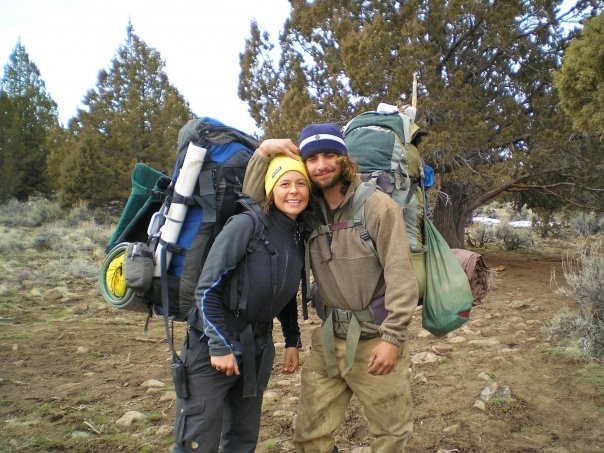
I became a better person because of wilderness therapy. All the communication techniques and sessions on manipulation and processing emotions worked on me, too. I had to take a hard look at myself during this time, especially when trying to teach others about these things, and then role model those techniques for an entire week, every other week, for years. Sure, I’m definitely not perfect, but I’m more aware now. So much more aware.
To all my wilderness therapy friends out there reading this, thank you for making my first few years in Bend so memorable, so impactful, and so amazing. It wasn’t always enjoyable, it wasn’t always pretty, but it was always so much fun to be in the desert with you.
 She-ra Hikes