In this entry I revisit the keynote speech I gave for the 2021 Greater Hells Canyon Council Gala…I posted this on Substack a few days ago, so if you find that platform easier to use, head on over here.
If I ever wrote a manifesto, it would probably sound a lot like this:
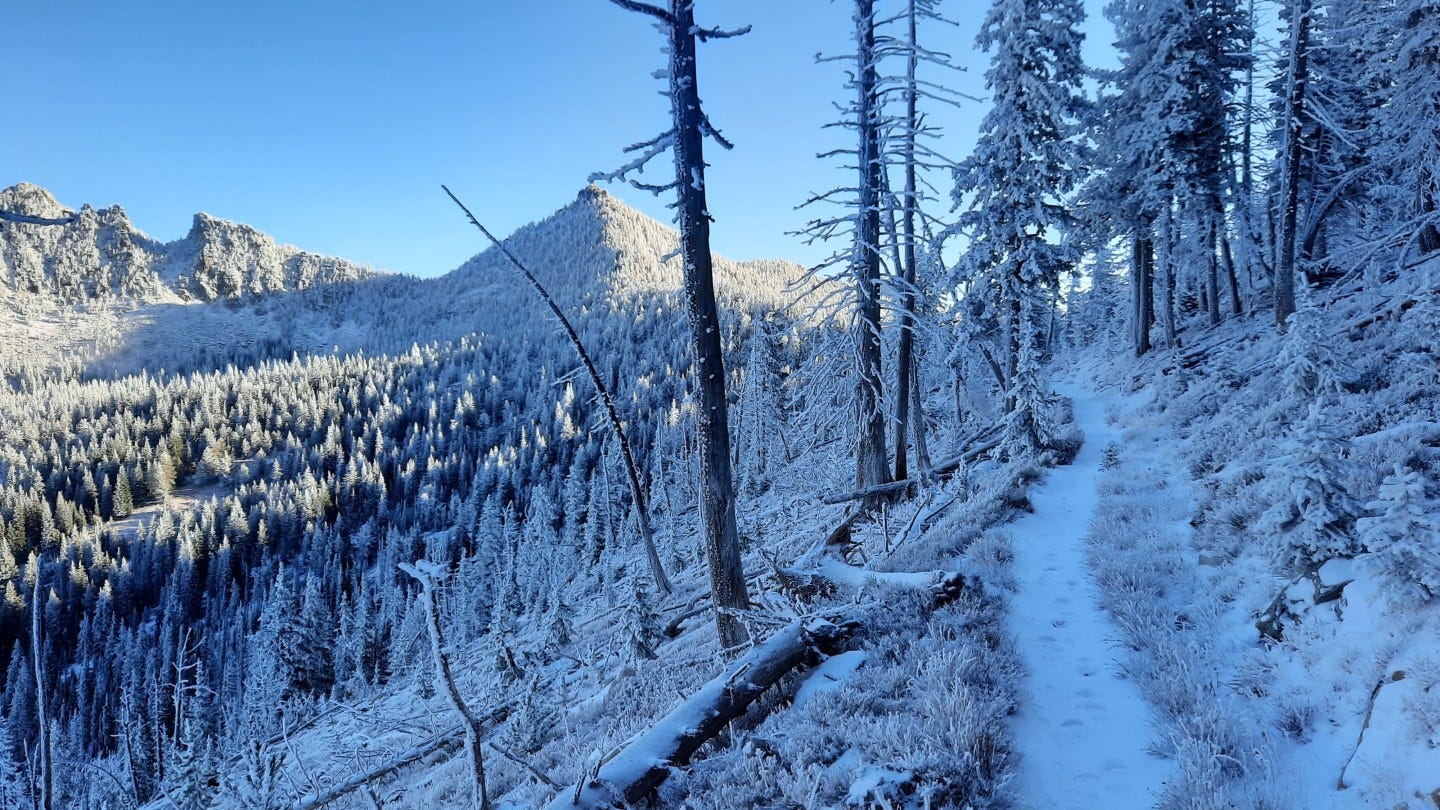
When I set out to ground-truth the new Blue Mountains Trail – in a year filled with the global trauma of a pandemic, social and civil unrest, and the heart-lurching consequences of climate change – I found the trail to be a refuge.
Walking soothed the ache of existing in a world embroiled with uncertainty and despair. Walking was a sigh of relief: my brain could relax, my body could relax, and in the absence of the online rage cycle, I could determine what was in my control. Often, I found control in the simplest of tasks, like deciding to eat a frosted strawberry pop-tart instead of a raisin and walnut oatmeal packet for breakfast, or what layers of fleece and gortex I would put on in the bitter October wind. A month filled with those simple tasks created an opportunity to live in the moment, to be fully present.
The Blue Mountains Trail helped me separate what was real: my interactions and relationships with nature and people, from what had been haunting me: a lack of control and power to influence the storm of hate and loss around me.
And what happened when I relaxed into the moment? I was able to find delight again. I marveled at the lasagna layers of canyon rock in Hells Canyon, Imnaha Canyon, and Joseph Canyon; I was transfixed by the blowing golden grasses of the Zumwalt Prairie, and gave shouts of excitement when I spied mountain goats in the North Fork of the John Day River canyon and along the Elkhorn Crest.
Awe, wonder, and delight helped me find my footing again in the world, and those emotions contribute to one of the biggest reasons why I think a new route like the Blue Mountains Trail is more important than ever. The trail is somewhere we can thrive outside of modern anxieties. The trail is where we can just be, and be in a landscape still untouched, in places, by the heavy hand of development.
Hikers who attempt a long journey such as the Blue Mountains Trail will be spending at least a month or more in their quest to walk over 500 miles. I like to call that deep time. To immerse yourself in a landscape and shake off the anxieties and stress of the modern world takes more than a week. In fact, I think it takes more than a month…six months is ideal.
Walking is one of the most intimate ways to connect to a place. Sleeping on the ground, drinking from cold springs bubbling up from the earth, and tracing the contours of the land with our stride is a very powerful experience. The explosion of popularity in thru-hiking since I started my long walks 20 years ago is a testament to that. A long-distance hike can be a truly life-changing experience, and now the Blue Mountains Trail can help us realize how to use that awe and wonder in the natural world to connect people to the specific challenges and hopes of the places we walk through.
Since I started the work of establishing the Oregon Desert Trail (a long-distance hiking route in southeast Oregon), I have evolved my views on the power of hiking to influence change in the world, and consequently, I believe we can ask more of the people who spend deep time in the wilderness.
Walking long distances is a transformative experience…the next step for the Blue Mountains Trail and organizations like the Greater Hells Canyon Council who steward and advocate for the water, land, and life that makes north eastern Oregon a biological refugia, is to take that joy and delight in the places we are spending a huge amount of our time in, and challenge us to become active participants in the future of those places. Someone who spends a month of their life walking beside free-flowing rivers, and then damned rivers, through old-growth forests and then logged forests, can see firsthand what is at stake when we talk about how there is not much land left that isn’t impacted by development and human influence.
I have come to see that the work to protect the last remaining stands of old-growth, and to protect the wildlife corridor that runs from the Rocky Mountains to the Pacific Ocean, is just as, or more important, than my personal experience of hiking the trail. In fact, it’s all connected. I think long-distance hikers are uniquely qualified to speak up and advocate for public land protections.
The Blue Mountains Trail is an opportunity to preach to the choir. Hikers are low-hanging fruit for the conservation community. How do I know? That was me.
When I started work on the Oregon Desert Trail in 2015, it was the first time I really paid attention to the conservation issues that impacted the land and water along the 750-mile route, and to be honest with you, mostly because it was my job. But as I spent more time developing the trail, I realized the conservation mission of the founding organization, Oregon Natural Desert Association, was what made it unique. ONDA created the ODT to engage the recreation community in the conservation issues of Oregon’s high desert. The Greater Hells Canyon Council’s decision to utilize that ethic in the new Blue Mountains Trail was affirming: one conservation organization creating a trail was a novelty; two conservation organizations creating trails is the start of a movement. Together, we can tie the recreation experience and conservation engagement in a more deliberate way.
What makes the Blue Mountains Trail and Oregon Desert Trail unique is that we are asking more of hikers. We are asking hikers to pay attention to the world around them, to pay attention to what makes adventures like these possible, to pay attention to the issues impacting the places we are walking through, and to participate in their future.
Before the Oregon Desert Trail, I had never been asked to do that before. No other long-distance trail had challenged me to pay attention and learn about the forests and wilderness areas I was hiking through, to use my experiences to reflect on public land management decisions and use my voice to help influence environmental policy. So, I think recreation experiences like the Blue Mountain Trail are the way forward as the world is facing the dire consequences of climate change and aggressive development. And trust me when I say that hikers want more: we want a deeper engagement, we want to know how it’s all connected, and we want to know what we can do about it.
We can demand more from quiet recreation in our work, and we need to preach to the choir. How many hikers are out there like myself who have never been asked to write a letter to the editor or comment on a resource management plan in the areas we spent days and weeks walking through and falling in love with? I know there are others like myself who want more trails, want more wild places, want more salmon and cougar and bear. We want to see wolves. We want there to be a full food chain that we are not necessarily at the top of, we want to see fire return to its natural, regenerative role in our forests, not just because it protects the trail tread, but because it protects the entire region we are walking through. We see on foot, we feel through our feet, how it’s all connected. By hiking, we are moving at a human pace; we are moving at the pace of life that has been the pace of life for thousands of years. That connection to the human experience since time immemorial is sometimes easy to forget off trail: that cars and airplanes and a super computer in everyone’s pocket has not always been the way, and in fact, cannot be the way much longer.
By going back to deep time in nature, we are going forward, and by keeping the continuity of a healthy planet and healthy ecosystem at the heart of our actions, we can truly realize our relationship to the natural world.
Through the Blue Mountains Trail we see it, we feel it, we know it, and we act on it.
 She-ra Hikes