Fix your gear

The fire spread in a blink of an eye and soon feathers were floating down around me like fat snowflakes. My down sleeping bag was the casualty in my momentary lapse of judgement that morning. I simply hadn’t let the alcohol dry on my hands when I lit my beer-can stove, and the moment my hand was on fire I waved it around (note: don’t do that) and splattered flames onto my sleeping bag.

It was day 100-something of my PCT thru-hike, and the only thing I could do was get out my patch kit of dental floss and a sewing needle to close up the 10 inch burn hole. Gathering as many feathers as I could, I stuffed them back in the gaping space that was once my sleeping bag and went to work.

You know what? That sleeping bag got me to Canada and I still have it. Its frankenstein mint-flavored patch job is still there. It still keeps me warm.

Don’t get me wrong, I love new gear. I have since purchased other sleeping bags. I have a -20 degree bag that was mandatory for the frigid nights during the two years I worked as a wilderness therapy staff in the deep winter of Central Oregon, I have a 40 degree quilt that I use for warmer summer nights when leading trail crews along the Oregon Desert Trail. There is a glut of cheap gear outlets, websites, and sales around the holidays, but I would love if we put more emphasis on reusing old gear, fixing our patches, zippers and waterproofing and making do with what we have.

Repair – Reuse – Recycle

We do it for cans, paper, glass. Lets do it with our gear.

When I moved to Bend over a decade ago, I was stoked to see we had two used gear shops in town; I had outfitted myself entirely from used gear sales for my 2006 PCT thru-hike. Then I noticed a gear repair booth set up at various outdoor events. Even better! My thrifty nature was directly related to spending all of my money on long distance hikes, so along the way I looked for ways to get the most out of my gear and my dollars. Repair, reuse, recycle.

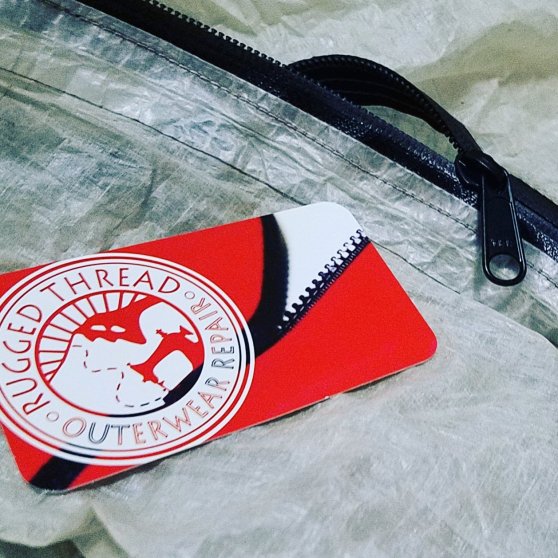
I first met Kim Kinney at a mutual friend’s art show. Kim was behind those gear repair booths I had been seeing, and she had the chops to fix almost any kind of outdoor gear. She had spent years working on custom gear design, and as an avid outdoors woman, she knows first hand what we put our gear through in the backcountry.

Kim has repaired several tents for me. I thought these would be intensive repair jobs; the zippers weren’t closing and seemed mangled, dirt and grime and years of backcountry use convinced me they needed to be replaced all together. It turned out to be quick and cheap and easy. New sliders on the zippers, was that it??
Before you throw out or donate that down coat with the burn hole, or that backpack with broken buckles, look into fixing it. I would imagine many mountain towns around the country have gear repair shops. Heck, even if you want to resell it on Craigslist, you will get more moolaa for it if it’s in good shape. Even if you break out the mint-flavored dental floss to sew up a tear, do it. Lets not throw more money down for things we don’t have to. Save it for that pizza and beer after hiking 100 miles through the Wind River Range, or after paddling a week in the Boundary Waters.

If you don’t have a gear repair shop near you, ship it to Kim. She works on a variety of gear, tents, backpacks and bags, motorcycle clothing, luggage and zippers. Find out more here.

Repair – Reuse – Recycle

Lets make fixing our gear the first step before buying something new.

Oh! And you don’t always have to have the fanciest gear… One of my favorite pieces of gear is a trash bag. It’s a rain skirt, pack cover, ground cloth, rain coat, stuff sack… You name it.
It’s time to embrace JOMO

I’ve been working with local Bend company, Food for the Sole, for the past year as they are getting their dehydrated adventure food business off the ground, and man are they killing it! I wrote a blog post for them recently that had nothing to do with their delicious vegan and gulten-free meals, but after hearing the term JOMO (Joy of Missing Out) I just had to write about it. JOMO is the antidote to FOMO (Fear of Missing Out).

Deep Time: A Call to Action for a Better World

outdoor-connection-wilderness

The drive to contribute to society and make a difference for the betterment of the world has been a pervasive theme in my life and those around me. It could have started when I joined the Peace Corps as a fresh-faced college grad. It could have roots in childhood when I was surrounded by my parents and their inspiring and idealistic friends, or it could have ties back to the volunteerism stressed by schooling and community groups over the years, but a part of me thinks it came about much more organically.

I believe my greatest foundation comes from a childhood spent climbing trees, building forts in the neighbor’s corn field, and riding bikes to the nearest swimming hole. It was time spent outside. Deep time.

As a child of the 80’s, our generation was blissfully unaware of the future where the masses would be closely tied to the machine in our pockets, where a legion of “online friends” would influence everything from voting to vacation destinations. FOMO, or Fear of Missing Out, is real, and is really impacting modern life. For fear of missing out, the phones are never far from wifi, and the tablets tuned into the 24/7 news cycles. The selfies are often sunny and the posts paint a picture that hide the more boring traces of reality.

I recently became acquainted with the term JOMO, and think it has the potential to flip our modern agnst around to instead embrace the Joy of Missing Out.

Thru-hikers know JOMO. Deep in the folds of mountain ranges where the 4G peters out and the sunlight filters in, we have to engage with the world around us. We watch aspen leaves shudder in the wind, and ants slowly build their kingdom. We know the pace of human breath and rhythmic beat of footsteps on trail.

All this can be experienced on a day hike or weekend excursion, but for true release from the need to be connected to the world of metadata and algorithms, I think we need more deep time.

Deep time: a long time spent in nature. A month is good, two is better, three to four months? Freaking fantastic. Deep time resets our internal clocks, resets our need to be observed and applauded all the time, resets our connections.


laughter-smiling-happiness.jpg

By embracing the Joy of Missing Out you are blissfully unaware of the latest movies, political maneuvers, memes and music, but you are blissfully aware of the full moon, the slow move of the seasons, and the transformation of your body that comes from walking every day, all day, through a landscape.

Can deep time in nature help create a better world? Can extended time in nature breed empathetic humans who want to contribute to the health of their communities? The wilderness doesn’t need us. The mountains don’t care if we are hiking or climbing, but this indifference to our comfort demands our respect, and we must rise to the occasion to stay safe, warm, and contented while outside. When spending deep time on a trail, we realize our connection to all around us, we are not separate from the woods, we are part of the woods. That respect has ripple effect. Yes. I do think deep time can change the world. At least it will change us.

Hikertrash Challenge

Our public lands are feeling the pressure of this government shutdown as record levels of trash and poop are building up in some of America’s favorite places (Joshua Tree National Park, Yosemite National Park, Crater Lake…) The federal workers who are mandated to care for these lands have been furloughed, and volunteers have come in to start picking up the trash in their absence.

Yet this poopy phenomenon is, sadly, nothing new. Ask PCT hikers in Southern California.

Ask kayakers about popular road-side river boating areas.

Go to any primitive car camping spot with a well established fire ring.

Chances are there will be trash, poop, and tp all over the place.

I was car camping on some BLM land near Bend this weekend, and while I was reading about the levels of trash left by grown adults who know better in our national parks and becoming outraged, I looked outside to see trash spread out over the sagebrush and lava rock right where I was camping.

NO MORE

Bring on the #hikertrashchallenge. It’s time to stop the madness and do more. Please pick up some trash on the public lands closest you, and if you like a good instagram post like me, use the hashtag #pickupyourhikertrash. Lets see what we can do.

So lets recap:

#1. Don’t litter
#2. Bury your poop
#3. Pack out your toilet paper
#4. Pick up trash (even if it isn’t yours)
#5. Repeat